How Growth-Focused Companies Choose an SEO Agency That Generates Revenue in 2026
Every year, leadership teams invest millions of dollars in initiatives designed to accelerate growth. They approve new technologies, expand sales teams, modernize operations, launch marketing campaigns, and hire external consultants—all with one objective: to build a stronger, more competitive business.
Daniel Harper
2026-07-10
How Growth-Focused Companies Choose an SEO Agency That Generates Revenue in 2026
An Executive Guide to Evaluating SEO Partners in the AI Search Era
Executive Summary
Every year, leadership teams invest millions of dollars in initiatives designed to accelerate growth. They approve new technologies, expand sales teams, modernize operations, launch marketing campaigns, and hire external consultants—all with one objective: to build a stronger, more competitive business.
Some of those decisions create lasting advantages.
Others quietly consume time, budget, and executive attention without delivering meaningful commercial impact.
Selecting an SEO agency belongs in the first category.
Although often viewed as a marketing decision, choosing an SEO partner is increasingly a strategic business decision. It influences how prospective customers discover your company, how they evaluate your expertise, how much they trust your brand, and ultimately whether they choose you over a competitor.
Yet despite the importance of that decision, many organizations continue evaluating SEO agencies using criteria that have little relationship to long-term business performance.
They compare monthly retainers.
They compare keyword reports.
They compare backlink numbers.
They compare deliverables.
These metrics have operational value.
They should not determine a strategic investment.
The organizations that consistently outperform their competitors approach SEO differently. They begin by asking a more fundamental question:
"What business problem are we trying to solve?"
That single question changes every conversation that follows.
Instead of measuring marketing activity, they evaluate commercial outcomes.
Instead of buying services, they build long-term capabilities.
Instead of chasing rankings, they invest in customer trust, digital authority, and sustainable growth.
This guide was written for executive teams who want to make that transition.
Whether you are a CEO evaluating your first SEO investment, a Marketing Director reviewing agency proposals, or a founder preparing your company for its next stage of growth, this publication provides a structured framework for making better decisions.
Throughout these chapters, we will explore:
Why traditional agency evaluation methods are becoming obsolete.
How artificial intelligence is changing search and customer discovery.
The characteristics that distinguish strategic partners from tactical vendors.
The questions every executive team should ask before signing an SEO agreement.
The metrics that actually matter to business leaders.
The warning signs that predict unsuccessful engagements.
A practical framework for comparing agency proposals objectively.
More importantly, this guide will encourage you to evaluate SEO differently.
Not as a marketing expense.
Not as a collection of technical tasks.
But as an investment in your organization's future ability to attract customers, build trust, and compete in increasingly digital markets.
Our goal is simple.
When you finish this guide, you should feel confident answering one question:
Which SEO partner is most likely to strengthen our business over the next three years—not merely improve our rankings over the next three months?
That is the question that matters.
Everything else is secondary.
Introduction
The Boardroom Decision That Most Companies Get Wrong
Monday.
9:00 a.m.
The executive leadership team gathers for its annual strategic planning meeting.
The agenda is ambitious.
Sales wants additional hiring.
Operations proposes new software.
Finance recommends tighter cost controls.
Marketing presents a proposal to increase investment in search engine optimization.
Three agencies have submitted proposals.
Each promises better rankings.
Each promises more traffic.
Each promises more leads.
Each presentation is polished.
Each case study appears convincing.
The CEO looks around the room and asks a simple question.
"Which agency gives us the highest probability of creating long-term business value?"
Silence follows.
Not because the answer is unimportant.
Because very few executive teams have been taught how to evaluate SEO as a strategic business capability rather than a marketing service.
Most organizations compare proposals based on activities.
Few compare them based on outcomes.
That distinction explains why two companies can spend similar budgets and achieve dramatically different results.
One organization builds an enduring competitive advantage.
The other accumulates reports.
The difference rarely comes down to technical optimization alone.
It comes down to strategy.
SEO Has Outgrown the Marketing Department
For much of the last decade, SEO was viewed primarily as a marketing function.
Marketing owned the website.
Marketing monitored rankings.
Marketing measured traffic.
Marketing managed the agency relationship.
That model no longer reflects how businesses grow.
Today, organic search influences nearly every stage of the customer journey.
Prospective customers research solutions before speaking with sales.
Procurement teams compare suppliers online before requesting proposals.
Patients evaluate healthcare providers before scheduling appointments.
Homeowners read reviews before calling contractors.
Business leaders validate expertise before booking consultations.
Search is no longer simply about being found.
It is about being trusted.
That shift has elevated SEO from a tactical marketing activity to a strategic business capability.
The executive team—not just the marketing department—now has a direct interest in whether the organization is building long-term digital authority.
The AI Search Era Changes the Conversation
Artificial intelligence has introduced a new layer of complexity.
Customers increasingly receive summarized answers instead of traditional lists of links.
Search engines interpret intent more effectively.
Recommendation systems evaluate credibility, authority, and usefulness in increasingly sophisticated ways.
For executives, this has created understandable uncertainty.
Questions such as:
Is SEO still worth investing in?
Will AI replace search?
Should we change our strategy?
How do we evaluate agencies claiming AI expertise?
are becoming increasingly common.
This guide addresses those questions directly, and our AI SEO Services are built specifically around them.
Not with speculation.
Not with marketing slogans.
But through evidence, strategic analysis, and practical decision frameworks.
A Different Kind of Guide
This publication is intentionally different from most SEO content.
You will not find:
Lists of "secret ranking factors."
Guaranteed growth formulas.
Inflated traffic claims.
Shortcuts designed to manipulate search algorithms.
Instead, you will find an executive framework for evaluating one of the most important growth investments your organization can make.
Some recommendations are supported by publicly available research and official search guidance, including Google Search Central. Others are presented as executive analysis based on established business principles. Wherever possible, we distinguish evidence from interpretation because leadership teams deserve clarity—not hype.
A Guiding Principle
Throughout this guide, one principle will appear repeatedly.
It is worth introducing now because it influences every chapter that follows.
Organizations rarely become market leaders because they optimize more keywords than their competitors.
They become market leaders because they better understand customers, communicate expertise more effectively, create superior digital experiences, and consistently earn trust over time.
Understanding that distinction changes how agencies should be evaluated.
It changes how success should be measured.
And ultimately, it changes how organizations compete.
The chapters that follow will show you how.
Chapter 1 — The Hidden Cost of Hiring the Wrong SEO Agency
Executive Problem
Every investment your leadership team approves competes for one scarce resource:
Time.
Money can be replaced.
Technology can be upgraded.
Marketing campaigns can be redesigned.
Time cannot be recovered.
When organizations choose the wrong SEO agency, the greatest loss is rarely the monthly retainer. It is the twelve to eighteen months spent executing a strategy that fails to strengthen the company's competitive position while competitors continue building authority, improving customer experiences, and capturing market share.
This hidden cost rarely appears on financial statements.
Yet it may be one of the most expensive consequences of a poor procurement decision.
Imagine two regional construction companies entering 2026 with similar revenue, comparable teams, and nearly identical marketing budgets.
The first company hires an agency that focuses on producing monthly reports, publishing generic blog posts, and celebrating ranking improvements for low-value keywords.
The second hires a strategic partner that begins by understanding the business, interviewing customers, analysing competitors, improving website performance, strengthening service pages, and aligning SEO with commercial priorities.
Twelve months later, both companies have invested similar amounts.
One has accumulated activity.
The other has built a durable competitive advantage.
The difference was never SEO alone.
The difference was the quality of the decision made before the first optimization was implemented.
Evidence Brief
Google's public guidance has remained remarkably consistent despite rapid changes in search technology. The company's recommendations continue to emphasize creating helpful, reliable, people-first content, maintaining technically accessible websites, and avoiding manipulative practices designed primarily to influence rankings.
This guidance reinforces an important executive principle:
Long-term search performance is rarely created by isolated tactics.
It is created by sustained improvements that make an organization genuinely more useful to customers.
For leadership teams, that means agency selection should prioritize strategic capability over tactical volume.
Why Most Companies Evaluate SEO Incorrectly
Walk into ten boardrooms where an SEO agency is being evaluated and the conversation usually sounds familiar.
Questions often include:
How many keywords will improve?
How many backlinks will you build?
How many articles are included?
How often will we receive reports?
How much do you charge each month?
These are reasonable operational questions.
They are not strategic questions.
The conversation should begin somewhere else.
Leadership teams should first ask:
"What business problem are we expecting SEO to solve?"
Because SEO can solve many different problems.
For one organization, the challenge is insufficient local visibility.
For another, it is low conversion rates.
For another, it is poor brand authority despite strong products.
For another, it is an inability to compete with larger national competitors.
Without clearly defining the commercial objective, agencies are left optimizing symptoms rather than addressing the underlying business challenge.
Executive Analysis
One of the biggest misconceptions surrounding SEO is that it should be evaluated like a marketing service.
It shouldn't.
It should be evaluated like a long-term business capability.
Consider how executive teams evaluate other strategic investments.
A new ERP system is not judged solely by the number of features installed.
A sales transformation is not judged by the number of training sessions delivered.
A manufacturing upgrade is not judged by the number of machines purchased.
Each investment is evaluated by its contribution to organizational performance.
SEO deserves the same level of executive scrutiny.
The objective is not more activity.
The objective is a stronger business.
That distinction changes every procurement conversation.
Instead of asking:
"How much SEO will we receive?"
Executive teams begin asking:
"How much stronger will our business become?"
That single change in perspective separates organizations that buy marketing services from organizations that build long-term competitive advantages.
The Opportunity Cost Framework
Every strategic investment should be evaluated across three dimensions.
Cost One: Financial Investment
This is the easiest cost to measure.
Agency retainers.
Content production.
Website improvements.
Technology.
Consulting.
These figures appear on invoices. Because they are visible, they often receive the greatest attention.
Cost Two: Organizational Attention
Successful SEO requires collaboration across multiple teams.
Marketing.
Sales.
Leadership.
Developers.
Content specialists.
Operations.
Choosing the wrong partner consumes valuable internal capacity that could have supported more productive initiatives. Unlike budget, executive attention cannot be expanded indefinitely. Every poor partnership competes with better opportunities.
Cost Three: Competitive Opportunity
This is the cost most organizations underestimate.
While your business spends twelve months executing an ineffective strategy, competitors continue investing.
Publish authoritative resources.
Earn customer reviews.
Improve website experience.
Strengthen brand visibility.
Expand local market presence.
Build topical authority.
These advantages compound over time. By the time an ineffective engagement is terminated, the competitive gap has often widened significantly. This is why selecting the right partner at the beginning matters more than changing partners later.
Industry Perspective
Home Services
The objective is not simply increasing website traffic. It is increasing profitable service bookings within defined service areas while reducing customer acquisition costs. An agency focused exclusively on rankings may overlook operational realities such as technician availability, seasonal demand, emergency services, and geographic profitability — the kind of nuance our HVAC SEO and Plumbing SEO programs are designed around.
Law Firms
A family law practice does not benefit equally from every website visitor. The commercial objective is attracting qualified consultations from prospective clients requiring specific legal expertise. Law Firm SEO strategy must therefore support authority, trust, and local visibility rather than maximizing informational traffic alone.
Ecommerce
Revenue growth depends on much more than search rankings.
Category architecture.
Product discoverability.
Checkout experience.
Website speed.
Customer trust.
Each influences commercial performance. An Ecommerce SEO agency that ignores these factors is solving only part of the growth equation.
Executive Decision Matrix
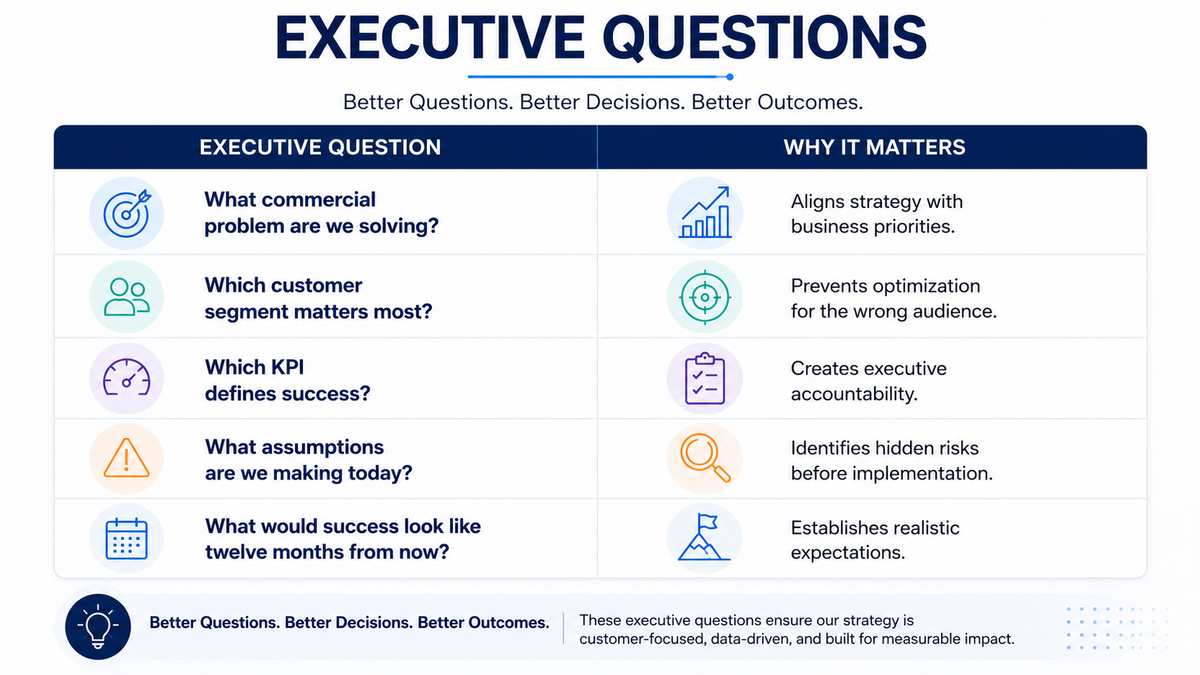
Before evaluating any agency proposal, every leadership team should agree on five questions.
Without consensus on these questions, comparing agency proposals becomes an exercise in comparing activities rather than outcomes.
Boardroom Discussion
Before moving to the next chapter, discuss the following with your leadership team.
If SEO disappeared tomorrow, what business challenge would become most difficult?
Which competitors are consistently winning online—and why?
Are we investing to improve rankings or to strengthen market position?
What evidence would convince us that an SEO partnership is creating real business value?
The answers often reveal whether the organization has defined the right objective before evaluating potential partners.
Executive Action
Schedule a one-hour strategy session before speaking with any SEO agency.
The agenda should not include tactics.
Instead, document:
Your top three business objectives.
Your most profitable customer segments.
Your biggest growth constraint.
The commercial metrics that matter to leadership.
The outcomes you expect one year after implementation.
This document should guide every agency conversation that follows. If you'd like help structuring it, you can Schedule a Strategy Session with our team.
Executive Summary
If you remember only one idea from this chapter, remember this:
The greatest cost of hiring the wrong SEO agency is not the money you spend. It is the competitive position your business fails to build while pursuing the wrong strategy.
Executive Quote
"Organizations rarely lose because they invested in SEO. They lose because they invested in the wrong strategy for too long."
Chapter 2 — Why Traditional SEO Evaluation No Longer Works
Executive Problem
Walk into almost any executive meeting where SEO performance is being reviewed and the dashboard looks familiar.
Keyword rankings.
Organic traffic.
Backlinks acquired.
Pages indexed.
Domain metrics.
Average position.
These metrics are not wrong.
They are simply incomplete.
The problem begins when organizations mistake marketing indicators for business outcomes.
A company can rank for thousands of keywords and still struggle to generate qualified leads.
It can double organic traffic while sales remain flat.
It can publish hundreds of articles without becoming the preferred choice in its market.
The disconnect exists because visibility alone does not create growth.
Visibility must translate into trust.
Trust must translate into action.
Action must translate into commercial value.
That transformation—not rankings—is what executive teams should evaluate.
Evidence Brief
Google's public guidance continues to emphasize creating content that is genuinely helpful to people rather than content designed primarily to satisfy search algorithms. Google's Search systems increasingly reward pages that demonstrate expertise, satisfy user intent, and provide a positive experience.
This reinforces a critical business reality.
Search engines are becoming increasingly effective at identifying content that creates value for users.
Organizations that optimize only for algorithms are competing against organizations that optimize for customers.
In the long run, customer-focused organizations generally build stronger digital assets.
The Evolution of Search
The role of search has changed dramatically over the past decade.
Originally, users searched primarily to find information.
Today they search to make decisions.
Compare providers.
Read reviews.
Watch demonstrations.
Verify expertise.
Evaluate pricing.
Research competitors.
Ask AI assistants for recommendations.
Visit multiple platforms before contacting a business.
Search has evolved from a discovery channel into a decision-making ecosystem.
That evolution requires businesses to think differently.
SEO is no longer just about attracting attention.
It is about influencing purchasing decisions throughout the customer journey.
Why Rankings Alone Are No Longer Enough
Imagine two companies.
Both rank first for an important industry keyword.
If the organization measures rankings, rankings improve.
If the organization measures revenue quality, strategy changes accordingly.
Executive leadership therefore has an important responsibility.
Choose metrics that reflect business success rather than marketing activity.
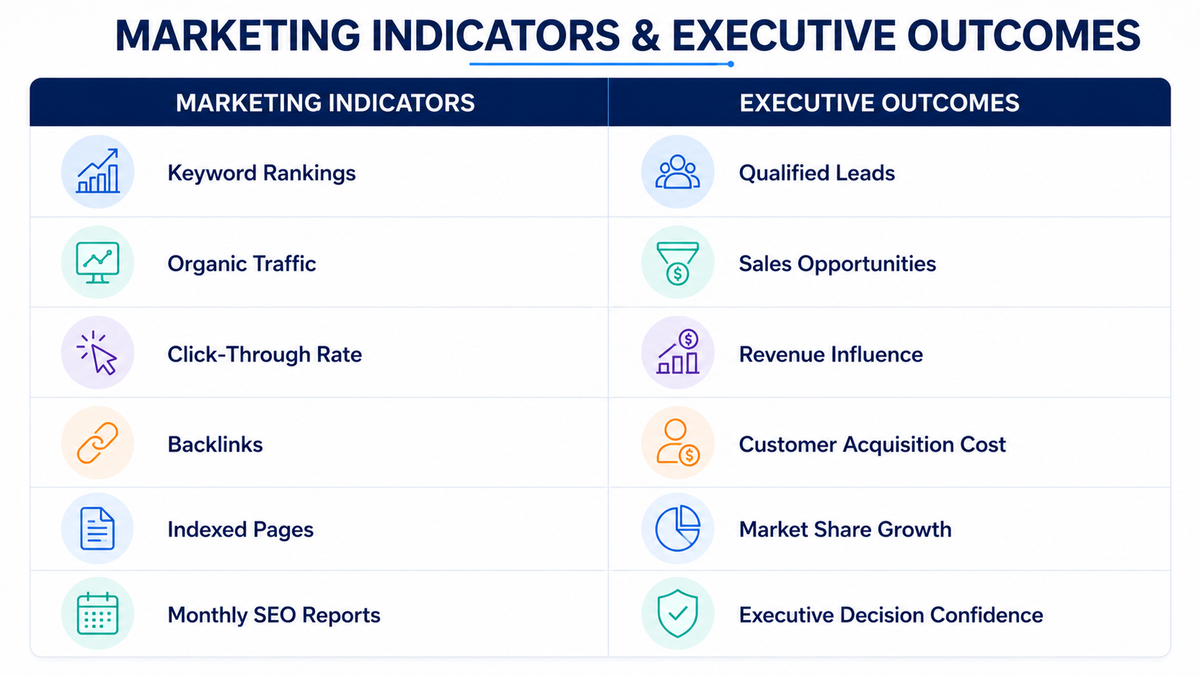
The Executive Growth Measurement Framework
Traditional SEO reporting should be viewed as operational reporting.
Executive reporting should answer a different question:
"Is our competitive position improving?"
The following framework separates marketing performance from business performance.
Marketing indicators remain valuable. They help teams optimize campaigns. Executive outcomes determine whether the investment is creating meaningful business value. Both matter. But they serve different audiences.
Industry Perspective
Healthcare
Healthcare organizations rarely succeed because they attract the most visitors. They succeed because prospective patients trust them. Educational resources, physician credibility, appointment availability, and patient experience often influence decisions more than search rankings alone — this is the core of our Healthcare SEO approach, and it applies equally to Dental SEO, Therapist SEO, and Veterinary SEO.
Financial Services
Financial decisions involve risk. Customers often research extensively before contacting an advisor. High-performing Financial SEO firms invest in educational content, transparent communication, and credibility. Search visibility introduces the brand. Trust wins the client.
Ecommerce
An ecommerce business can increase traffic by fifty percent while experiencing declining profitability. Why? Because traffic quality matters more than traffic quantity. Successful Ecommerce SEO focuses on attracting buyers—not browsers.
Home Services
A local plumbing company benefits more from twenty emergency service requests than two thousand informational visits. Plumbing SEO strategy should reflect commercial priorities rather than vanity metrics.
Executive Decision Matrix
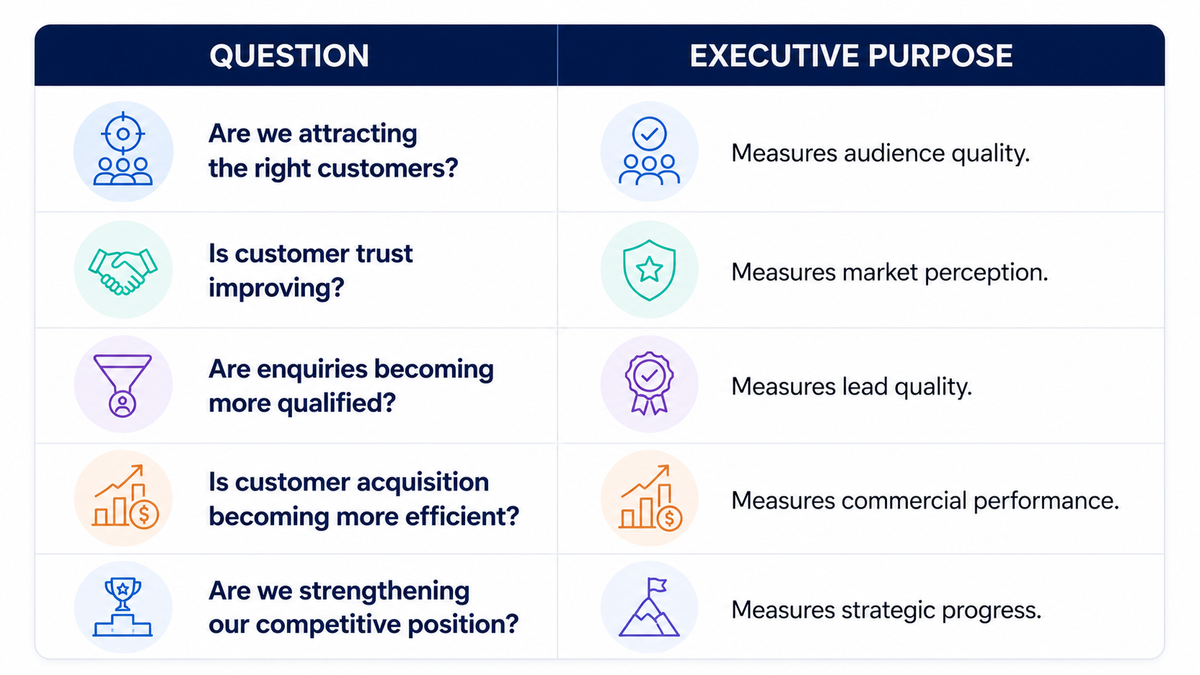
Every executive dashboard should answer five questions.
If reporting cannot answer these questions, leadership lacks the information required for informed decision-making.
Boardroom Discussion
Review your current SEO reporting. Ask your leadership team:
Which metrics directly influence executive decisions?
Which metrics primarily support marketing optimization?
What business outcome should improve if SEO is successful?
How frequently should leadership review strategic progress?
Which KPI would matter most if rankings disappeared tomorrow?
These discussions often reveal whether your organization is measuring performance or simply monitoring activity.
Executive Action
Request two separate reports from your agency.
Report One — Operational Performance
Prepared for the marketing team. Focus on:
Rankings.
Technical improvements.
Content production.
Organic visibility.
Search performance.
Report Two — Executive Business Review
Prepared for leadership. Focus on:
Qualified enquiries.
Consultation requests.
Pipeline contribution.
Customer acquisition trends.
Competitive movement.
Strategic priorities.
Key business risks.
This distinction creates better conversations. Marketing teams receive the operational detail they need. Leadership receives the strategic insight required to make informed decisions.
Executive Summary
If there is one lesson to take from this chapter, it is this:
Rankings are a means to an end—not the end itself.
Organizations that consistently outperform competitors understand that SEO is valuable because it strengthens customer acquisition, brand authority, and commercial performance.
Those outcomes—not rankings—should define success.
Executive Quote
"Rankings create visibility. Trust creates preference. Commercial execution transforms both into sustainable growth."
Chapter 3 — The AI Search Era Has Changed the Rules
Executive Problem
Artificial intelligence has become the most discussed topic in digital marketing.
Every week brings a new headline.
"SEO is dead."
"AI will replace search."
"Large Language Models are the future."
"Traditional search is disappearing."
For executive teams responsible for allocating marketing budgets, these headlines create understandable uncertainty.
Should the organization continue investing in SEO?
Should the strategy change?
Should existing agency partnerships be reconsidered?
Or is this simply another technology cycle surrounded by excessive hype?
The challenge is not the pace of innovation.
It is separating meaningful change from marketing noise.
Organizations that overreact risk abandoning proven strategies.
Organizations that ignore change risk losing competitive advantage.
Leadership teams therefore need a balanced understanding of what AI has actually changed—and what remains fundamentally the same.
Evidence Brief
Google has publicly stated that AI-powered experiences, including AI Overviews and AI Mode, build upon the same core Search systems that have supported Google Search for years. Websites do not require a separate technical optimization strategy to become eligible for these experiences. Instead, Google's guidance continues to emphasize:
Helpful, people-first content.
Strong technical accessibility.
Clear website architecture.
Demonstrated expertise.
Positive user experience.
While search interfaces are evolving, Google's core objective remains unchanged:
Deliver the most useful information for each user's intent.
For executives, this distinction matters.
The interface has evolved.
The principles have remained remarkably consistent.
Why Most Companies Get This Wrong
Whenever technology changes, markets create new terminology.
The AI era has introduced phrases such as:
AI SEO.
Answer Engine Optimization (AEO).
Generative Engine Optimization (GEO).
LLM Optimization.
Some concepts behind these terms are useful.
Others are largely marketing labels describing practices that already existed under different names.
This creates confusion during procurement.
Businesses begin asking agencies:
"Do you offer AI SEO?"
The more important question is:
"How does your strategy help our organization become the most trusted source of information within our market?"
Artificial intelligence has not reduced the importance of trust.
It has increased it.
Executive Analysis
Every major technological shift creates two kinds of organizations.
The first group reacts to every trend.
The second group strengthens the underlying capabilities that remain valuable regardless of technological change.
History consistently rewards the second approach.
Organizations that built strong brands survived the rise of social media.
Organizations that invested in customer experience adapted more effectively to ecommerce.
Organizations that embraced digital transformation before it became fashionable entered new markets faster than competitors.
AI search follows the same pattern.
The companies most likely to succeed are not necessarily those adopting every new AI tool.
They are those that consistently produce original expertise, earn customer trust, maintain technically excellent websites, and communicate their value clearly.
Technology accelerates discovery.
It cannot manufacture credibility.
The Digital Authority Model
Many organizations mistakenly believe visibility begins with keywords.
In reality, sustainable visibility begins much earlier.
Business Expertise
Original Knowledge
Helpful Content
Technical Excellence
Positive User Experience
Customer Trust
Digital Authority
Search Visibility
Qualified Demand
Revenue Growth
This model illustrates an important principle.
Search visibility is not the starting point.
It is the outcome.
Businesses that focus exclusively on rankings often overlook the capabilities that make rankings sustainable. Businesses that invest in expertise, customer value, and technical quality create durable competitive advantages that extend beyond any individual search feature.
What AI Changes for Executive Teams
Artificial intelligence should change the questions leadership asks prospective agencies.
Old Question: How many keywords can you rank?
Better Question: How will you help our organization become the most trusted source within our category?
Old Question: How many articles will you publish?
Better Question: How will your content demonstrate expertise that competitors cannot easily replicate?
Old Question: Which AI tools do you use?
Better Question: How do AI tools improve quality, efficiency, and strategic insight without compromising originality?
These questions move the discussion away from technology and toward business capability.
Industry Perspective
Healthcare
Patients increasingly consult AI assistants and search engines before contacting healthcare providers. Organizations publishing medically accurate, patient-focused educational resources strengthen both trust and discoverability, which is central to effective Healthcare SEO.
Legal Services
Potential clients often research legal issues before speaking with an attorney. Firms that consistently explain complex legal topics in accessible language build authority long before the first consultation, a core pillar of Law Firm SEO.
Ecommerce
AI can summarize product information.
It cannot replace authentic customer reviews, compelling product experiences, transparent policies, or strong brand reputation.
Competitive advantage increasingly comes from combining exceptional customer experience with authoritative product information.
B2B Professional Services
Decision-makers rarely purchase complex services based solely on AI summaries. They evaluate:
Expertise.
Thought leadership.
Case studies.
Industry knowledge.
Executive confidence.
These remain fundamentally human decisions.
Executive Decision Matrix
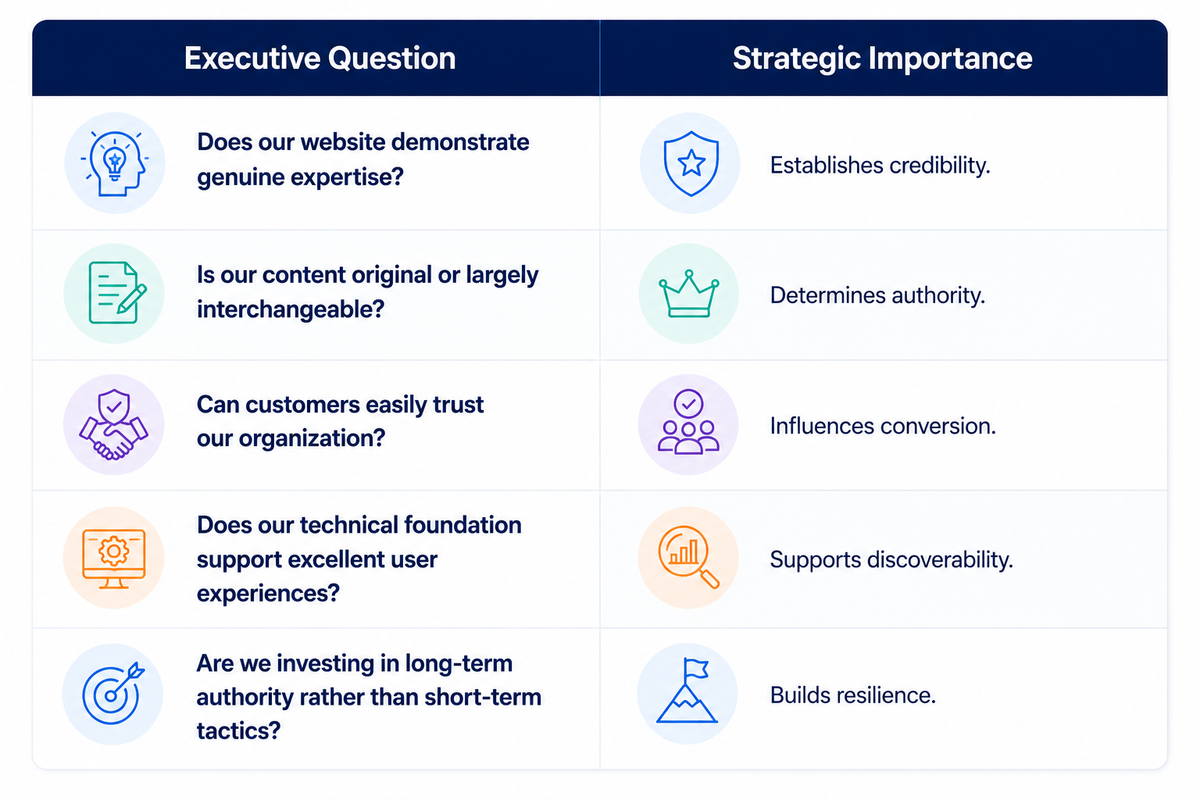
Evaluate your organization's readiness for AI search by asking five questions.
Organizations answering "yes" consistently are likely to adapt successfully regardless of future changes in search technology.
Boardroom Discussion
Discuss the following questions during your next leadership meeting.
If AI assistants recommended three companies in our market, why should ours be included?
What evidence demonstrates our expertise?
Which content genuinely teaches customers something competitors do not?
Does our website communicate authority—or simply information?
Which investments today will still create value five years from now?
These questions encourage leadership teams to think beyond algorithms and toward sustainable competitive positioning.
Executive Action
Conduct an Authority Audit.
Review your website and ask:
Which pages demonstrate original thinking?
Which pages simply repeat industry information?
Where can your organization contribute unique expertise?
Which customer questions remain unanswered?
What evidence supports your claims?
The objective is not simply to publish more content.
It is to publish information worthy of being referenced. If you want a professional set of eyes on this, you can Request an SEO Audit from our team, powered by our SEO Audit process.
Executive Summary
Artificial intelligence has changed how customers discover information.
It has not changed why customers choose one business over another.
Organizations still earn preference through expertise, trust, relevance, and exceptional customer experiences.
AI simply increases the importance of demonstrating those qualities consistently.
Executive Quote
"Artificial intelligence can accelerate discovery. It cannot replace earned trust. Organizations that become the most credible source in their market will remain discoverable regardless of how search continues to evolve."
Chapter 4 — The Executive SEO Partner Evaluation Framework
Executive Problem
Every year, executive teams invest significant time evaluating strategic partners.
They compare:
Accounting firms.
Technology vendors.
Legal advisors.
Management consultants.
Cybersecurity providers.
Each decision follows a structured evaluation process because the consequences of choosing the wrong partner are significant.
Curiously, SEO agencies are often evaluated very differently.
Leadership teams frequently rely on:
Sales presentations.
Client testimonials.
Monthly pricing.
Lists of deliverables.
Portfolio screenshots.
Personal chemistry.
While each of these factors provides useful information, none of them answers the question executives should care about most:
"Which agency is most capable of helping our business create sustainable competitive advantage?
Without a structured evaluation framework, procurement becomes subjective.
Subjective procurement often rewards confidence over competence.
The objective of this chapter is to replace intuition with disciplined evaluation.
Evidence Brief
Research in procurement and decision science, including analysis published by Harvard Business Review, consistently shows that structured evaluation frameworks improve decision quality by reducing bias, encouraging objective comparisons, and aligning stakeholders around common criteria.
The same principle applies when selecting an SEO partner.
The strongest decisions are rarely made by choosing the most persuasive proposal.
They are made by consistently evaluating every proposal against the same business criteria.
Why Most Procurement Processes Fail
Most organizations unknowingly evaluate agencies in the wrong order.
The conversation typically begins with:
Price.
Deliverables.
Contract length.
Only later do they discuss:
Strategy.
Commercial understanding.
Customer acquisition.
That sequence should be reversed.
Pricing should become relevant only after leadership has determined which agency demonstrates the strongest strategic capability.
Choosing an agency because it costs less is rarely a competitive strategy.
Choosing the agency most capable of creating measurable business value often is.
Executive Analysis
The most successful agency relationships begin long before implementation.
They begin during evaluation.
An experienced agency should demonstrate its value before a contract is signed.
Not through promises.
Through thinking.
By the end of the proposal process, leadership should clearly understand:
How the agency thinks.
How it prioritizes.
How it communicates.
How it manages uncertainty.
How it defines success.
How it makes decisions.
If those questions remain unanswered after multiple meetings, procurement is incomplete.
The objective is not simply to hire experts.
It is to hire an organization whose decision-making process strengthens your own.
The Executive SEO Partner Evaluation Framework
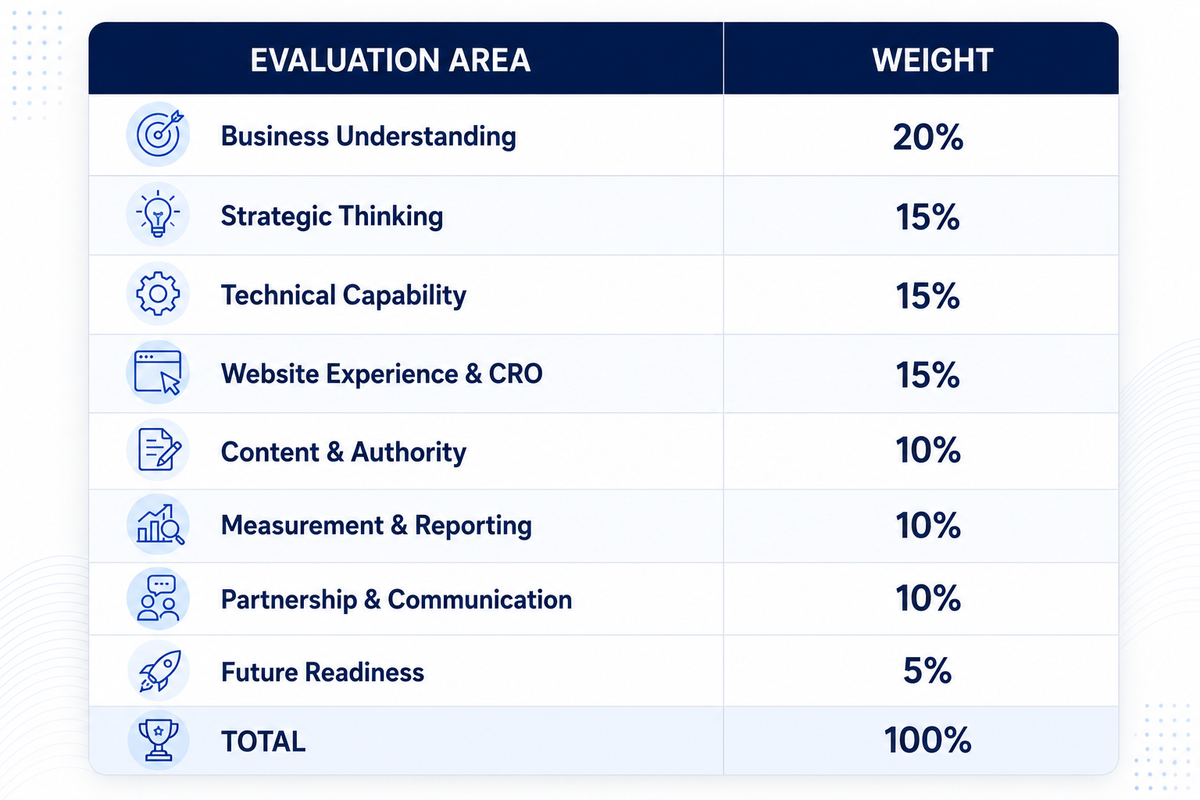
To reduce subjectivity, evaluate every agency across eight strategic dimensions.
1. Business Understanding (20%)
Before discussing SEO, the agency should understand:
Revenue model.
Customer journey.
Buying behaviour.
Competitive landscape.
Growth objectives.
Operational constraints.
Questions to ask:
What do you believe is our biggest commercial challenge?
Which customer segment should we prioritize first?
What assumptions have you made about our business?
A strong agency asks insightful business questions before recommending tactical solutions.
2. Strategic Thinking (15%)
A proposal should explain:
Why recommendations matter.
Which opportunities deserve priority.
What trade-offs exist.
How success will be measured.
Warning sign: A proposal consisting primarily of task lists without strategic reasoning.
3. Technical Capability (15%)
Technical SEO should support business growth rather than exist as an isolated discipline.
Evaluate whether the agency can:
Diagnose technical barriers.
Prioritize implementation.
Explain commercial impact.
Collaborate with development teams.
Technical expertise matters — this is where our Technical SEO Services and Website Development team work hand in hand. The ability to connect technical improvements to business outcomes matters even more.
4. Content & Digital Authority (10%)
Ask:
How will you help us become the most trusted source in our industry?
What differentiates our content strategy from competitors?
How will you demonstrate expertise rather than simply publish content?
Remember: Authority compounds. Content production alone does not.
This is the core focus of our Conversion Rate Optimization work. An agency focused exclusively on traffic may overlook significant commercial opportunities.
6. Measurement & Executive Reporting (10%)
Executive reporting should answer four questions:
What changed?
Why did it change?
What business impact did it create?
What decision should leadership make next?
Reporting should improve executive decision-making—not simply document marketing activity.
7. Partnership & Communication (10%)
The strongest agencies communicate like advisors rather than vendors.
Evaluate:
Transparency.
Responsiveness.
Ability to explain complexity simply.
Willingness to challenge assumptions.
Executive communication style.
Leadership should leave meetings with greater clarity, not greater confusion.
8. Future Readiness (5%)
Search will continue evolving.
Ask:
How do you adapt to changes in AI-powered search?
How do you validate new strategies?
Which SEO fundamentals remain constant despite technological change?
Future-ready agencies distinguish enduring principles from temporary trends.
Executive Evaluation Scorecard
Each stakeholder should complete the scorecard independently before discussing results as a group. Independent scoring reduces confirmation bias and encourages more objective procurement decisions.
Industry Perspective
Although every industry has unique characteristics, the evaluation framework remains remarkably consistent.
Healthcare — The agency should demonstrate understanding of patient trust, local visibility, compliance considerations, and appointment acquisition.
Law Firms — The discussion should focus on practice-area authority, consultation quality, and competitive differentiation—not simply keyword rankings.
Ecommerce — The proposal should address category architecture, product discoverability, conversion optimization, and customer lifetime value.
Home Services — Recommendations should reflect geographic priorities, seasonal demand, operational capacity, and profitable service categories, as we outline in our Contractor SEO and Construction SEO programs.
The technical recommendations differ. The procurement principles do not.
Boardroom Discussion
Before selecting an agency, ask your executive team:
Which proposal demonstrates the deepest understanding of our business?
Which agency challenged our assumptions instead of confirming them?
Which recommendations appear customized rather than templated?
Which partner would we trust during an unexpected market disruption?
Which organization would strengthen our decision-making over the next three years?
These questions often reveal the strongest partner before pricing discussions even begin.
Executive Action
Require every shortlisted agency to answer one final question:
"If you could improve only three aspects of our digital business during the next twelve months, what would they be—and why?"
The quality of that answer reveals more about strategic capability than almost any presentation.
It demonstrates:
Prioritization.
Commercial understanding.
Executive thinking.
And the ability to distinguish important work from merely urgent work.
Executive Summary
Selecting an SEO agency should resemble selecting a long-term business advisor—not purchasing a monthly marketing service.
The strongest proposals demonstrate structured thinking, commercial understanding, disciplined prioritization, and the ability to strengthen organizational decision-making.
Those qualities create lasting partnerships.
Deliverables alone do not.
Executive Quote
"The agency you choose will influence far more than your search rankings. It will influence how your organization competes, learns, and grows in an increasingly digital marketplace."
Chapter 5 — Executive Due Diligence: The Questions Every Leadership Team Should Ask Before Signing an SEO Agreement
Executive Problem
The quality of a business partnership is rarely determined after the contract is signed.
It is usually determined before the contract is signed.
The conversations that take place during procurement establish expectations, define accountability, reveal strategic thinking, and expose potential risks long before implementation begins.
Yet many organizations conduct surprisingly limited due diligence when selecting an SEO agency.
They evaluate proposals.
Review testimonials.
Attend presentations.
Negotiate pricing.
Sign the agreement.
Only later do they begin asking the questions that should have been answered from the beginning.
Questions such as:
Who actually performs the work?
How are priorities established?
What happens if results are slower than expected?
How will disagreements be resolved?
Which assumptions support the proposed strategy?
What responsibilities belong to our internal team?
By the time these questions emerge, changing direction becomes significantly more expensive.
Effective due diligence reduces that risk.
Its objective is not to eliminate uncertainty.
Its objective is to ensure both organizations begin the partnership with a shared understanding of success, accountability, and execution.
Evidence Brief
Across management consulting, procurement, and professional services — themes regularly explored by McKinsey & Company — long-term partnerships consistently outperform transactional relationships when three conditions exist:
Clear expectations.
Transparent communication.
Shared accountability.
Organizations that invest time in structured due diligence before selecting strategic partners generally experience fewer misunderstandings, faster implementation, and stronger long-term collaboration.
SEO partnerships are no different.
Why Most Companies Ask the Wrong Questions
Many agency interviews focus almost entirely on capability.
Leadership asks:
How many years have you been in business?
Which industries do you serve?
Which tools do you use?
How many specialists are on your team?
These questions have value.
However, they rarely reveal how the partnership will function once implementation begins.
More important questions include:
How do you prioritize competing opportunities?
What assumptions have you made about our business?
Which risks concern you most?
How do you handle disagreements over strategy?
How should executive leadership participate during the engagement?
Capability earns consideration.
Operational maturity earns confidence.
Executive Analysis
One of the defining characteristics of high-performing consulting firms is that they make expectations explicit.
Nothing important is assumed.
Success is defined before implementation begins.
Responsibilities are documented.
Communication is structured.
Risks are discussed openly.
The same discipline should apply to SEO.
A mature agency should never hesitate to explain:
What success looks like.
What failure might look like.
Which assumptions support the strategy.
Which factors remain outside its control.
Organizations that openly discuss uncertainty generally inspire greater confidence than those promising certainty.
Transparency is often a stronger predictor of long-term partnership quality than optimism.
The Executive Due Diligence Framework
Evaluate every prospective agency across five dimensions before making a final decision.
Stage 1 — Business Understanding
Objective: Determine whether the agency genuinely understands your organization.
Questions:
What do you believe is our biggest growth opportunity?
What concerns you most about our current strategy?
Which competitors deserve our closest attention?
What assumptions have you made so far?
Expected Outcome: Leadership should feel understood—not sold to.
Stage 2 — Strategic Alignment
Objective: Confirm that recommendations support business priorities.
Questions:
Why are these initiatives prioritized first?
Which recommendations create the greatest commercial impact?
What trade-offs should leadership understand?
How will priorities evolve during the first year?
Expected Outcome: A roadmap driven by business value rather than tactical volume.
Stage 3 — Execution Capability
Objective: Understand how work becomes reality.
Questions:
Who owns implementation?
Which work is outsourced?
How are technical recommendations delivered?
How frequently are priorities reviewed?
How do you manage delays or dependencies?
Expected Outcome: A realistic implementation model with clearly defined responsibilities.
Expected Outcome: Reporting that supports executive decision-making rather than merely documenting activity.
Stage 5 — Risk & Adaptability
Objective: Evaluate resilience.
Questions:
Which assumptions could prove incorrect?
How would the strategy change if market conditions shifted?
How do you evaluate emerging search technologies?
What would cause you to recommend changing direction?
Expected Outcome: Confidence that the agency can adapt responsibly without abandoning proven principles.
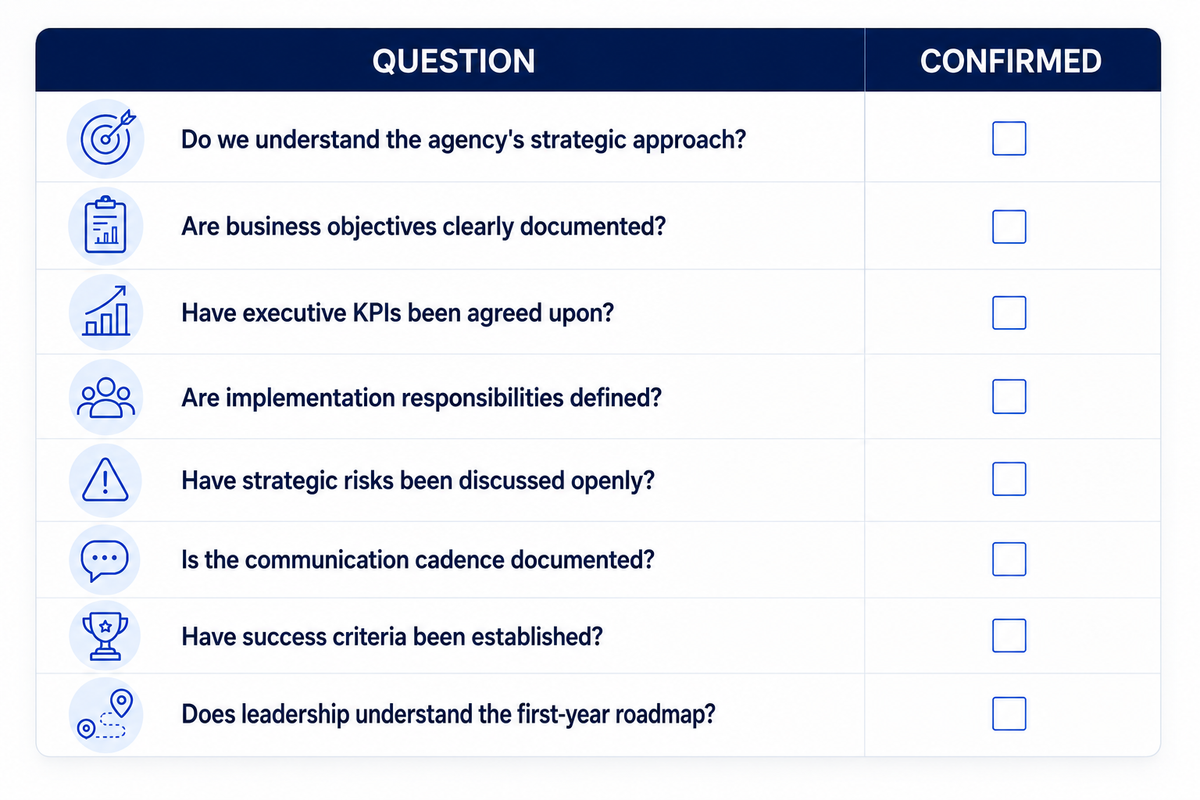
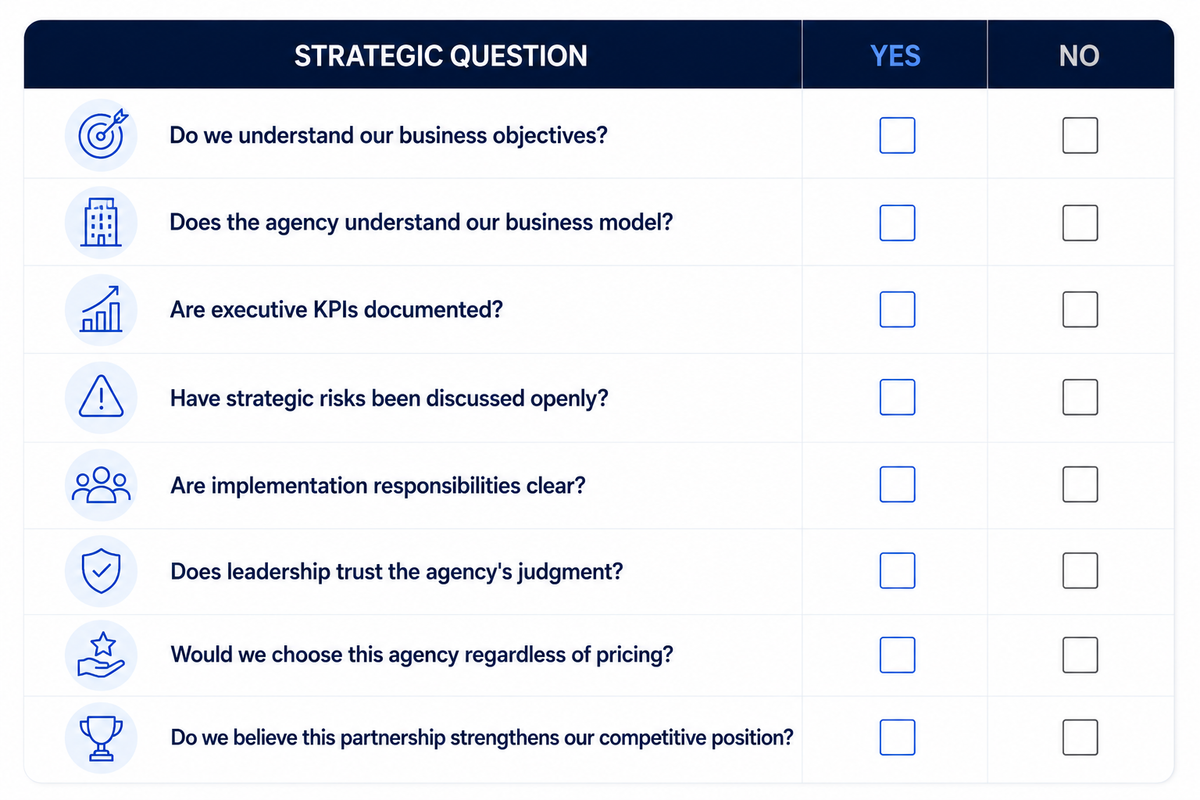
Executive Due Diligence Checklist
Before signing any agreement, confirm that leadership can confidently answer the following questions.
If several boxes remain unchecked, procurement should continue before contracts are finalized.
Industry Perspective
Healthcare — Due diligence should include discussions around patient acquisition, trust, local visibility, compliance considerations, and appointment workflows—not only traffic projections.
Financial Services — Leadership should understand how authority, educational content, and regulatory considerations influence long-term digital growth, an area covered in depth by our Insurance SEO work.
Construction & Home Services — Execution discussions should include service territories, seasonal demand, operational capacity, review generation, and lead qualification, as reflected in our Roofing SEO and Home Remodeling SEO programs.
Ecommerce — The agency should demonstrate a clear understanding of merchandising priorities, product architecture, conversion optimization, analytics, and customer retention.
Different industries require different strategies. They all require disciplined due diligence.
Boardroom Discussion
Before approving the final agency selection, ask your executive team:
Which unanswered questions remain?
Which assumptions concern us most?
Where could this partnership fail?
What would success realistically look like after twelve months?
Do we understand our own responsibilities as clearly as the agency's?
An uncomfortable conversation before signing a contract is usually less expensive than a difficult conversation six months later.
Executive Action
Conduct a formal "Decision Readiness Meeting" before signing.
Invite executive leadership, marketing, sales, and any operational stakeholders involved in implementation.
Review:
Strategic objectives.
Agency scorecards.
Due diligence findings.
Risk register.
First-year roadmap.
Success metrics.
Do not discuss pricing until the organization agrees on which partner is most capable of creating long-term business value. Once strategic alignment has been established, commercial negotiations become significantly more productive.
Executive Summary
Exceptional partnerships are rarely built on impressive presentations.
They are built on disciplined evaluation, transparent communication, shared expectations, and mutual accountability.
The strongest agency selection processes do not eliminate uncertainty.
They reduce unnecessary risk while increasing executive confidence.
Executive Quote
"Procurement should not answer the question, 'Which agency can we afford?' It should answer the question, 'Which partner gives us the greatest confidence in our future competitiveness?'"
Chapter 6 — The Warning Signs: Seven Red Flags That Predict an Unsuccessful SEO Partnership
Executive Problem
Most organizations do not wake up one morning and suddenly realize they hired the wrong SEO agency.
The realization arrives gradually.
Monthly reports continue to arrive.
Meetings continue to be scheduled.
Content continues to be published.
Technical audits continue to grow longer.
Yet something feels wrong.
Sales has not noticed a meaningful improvement in lead quality.
Customer acquisition costs remain unchanged.
Revenue growth continues to lag behind expectations.
Competitors appear increasingly visible.
Executive confidence slowly begins to erode.
By the time leadership acknowledges that the partnership is underperforming, twelve to eighteen months have often passed.
The financial investment is recoverable.
The lost time is not.
This chapter is designed to help executive teams recognize warning signs before they become expensive business problems.
The objective is not to find the perfect agency.
No such agency exists.
The objective is to identify patterns that consistently predict long-term success—or long-term disappointment.
Evidence Brief
Google has consistently advised businesses to avoid agencies promising guaranteed rankings, manipulative link-building schemes, or tactics designed primarily to exploit search algorithms.
Independent procurement research also shows that poor vendor relationships are usually caused not by technical incompetence but by misaligned expectations, weak communication, unclear governance, and inadequate strategic planning.
In other words, the problems that destroy partnerships often begin long before execution starts.
Why Red Flags Matter More Than Sales Presentations
Every agency has strengths.
Every agency has limitations.
Experienced executive teams understand that selecting a partner is less about identifying perfection and more about identifying risk.
Some of the strongest sales presentations belong to organizations with inconsistent delivery.
Likewise, some outstanding agencies invest very little in marketing themselves.
The challenge for executive leadership is to distinguish persuasive storytelling from operational excellence.
That requires looking beyond what agencies choose to highlight.
It requires identifying what they avoid discussing.
Executive Analysis
One of the most valuable habits executive teams can develop is learning to evaluate uncertainty.
Strong agencies openly discuss:
Assumptions.
Risks.
Dependencies.
Trade-offs.
Alternative strategies.
Weak agencies often replace uncertainty with confidence.
Paradoxically, the agency that promises certainty should usually be questioned more rigorously than the agency that explains complexity honestly.
Transparency builds trust.
Overconfidence creates risk.
The Seven Executive Red Flags
Red Flag 1 — Recommendations Before Discovery
If an agency recommends a detailed SEO strategy before understanding your business model, customers, competitors, operations, and commercial objectives, it is optimizing assumptions rather than reality.
Every strategic recommendation should follow discovery—not precede it.
Red Flag 2 — Guaranteed Rankings
No agency controls Google's algorithms.
Professional agencies control:
Research quality.
Technical execution.
Content quality.
Strategic thinking.
Continuous improvement.
They do not control rankings.
Guarantees often signal unrealistic sales positioning rather than mature consulting.
Red Flag 3 — SEO Exists In Isolation
SEO does not operate independently.
Search performance depends upon:
Website experience.
Conversion optimization.
Brand trust.
Customer reviews.
Sales processes.
Technical infrastructure.
Content quality.
An agency that ignores these relationships is solving only one part of a much larger commercial challenge.
Red Flag 4 — Reporting Focuses On Activity Rather Than Decisions
Many organizations receive thirty-page reports every month.
Very few receive executive insight.
Good reporting answers:
"What happened?"
Excellent reporting answers:
"What should leadership do next?"
The difference is enormous.
Red Flag 5 — Every Client Receives The Same Solution
Every market behaves differently.
Every customer journey differs.
Every competitive landscape evolves uniquely.
A proposal that appears interchangeable across industries usually reflects standardized delivery rather than strategic thinking.
Customization demonstrates understanding.
Templates demonstrate efficiency.
Executive teams need both—but understanding should always come first.
Red Flag 6 — AI Becomes The Entire Strategy
Artificial intelligence is a powerful capability.
It is not a business strategy.
Agencies that position AI as the primary differentiator often struggle to explain the enduring principles behind sustainable growth.
Technology should enhance strategy.
Never replace it.
Red Flag 7 — Difficult Questions Receive Vague Answers
Ask an agency:
"What happens if our assumptions prove incorrect?"
or
"What would make you change this strategy?"
Their response reveals far more than their sales presentation.
Strong agencies explain their reasoning.
Weak agencies repeat marketing language.
The willingness to discuss uncertainty often reflects organizational maturity.
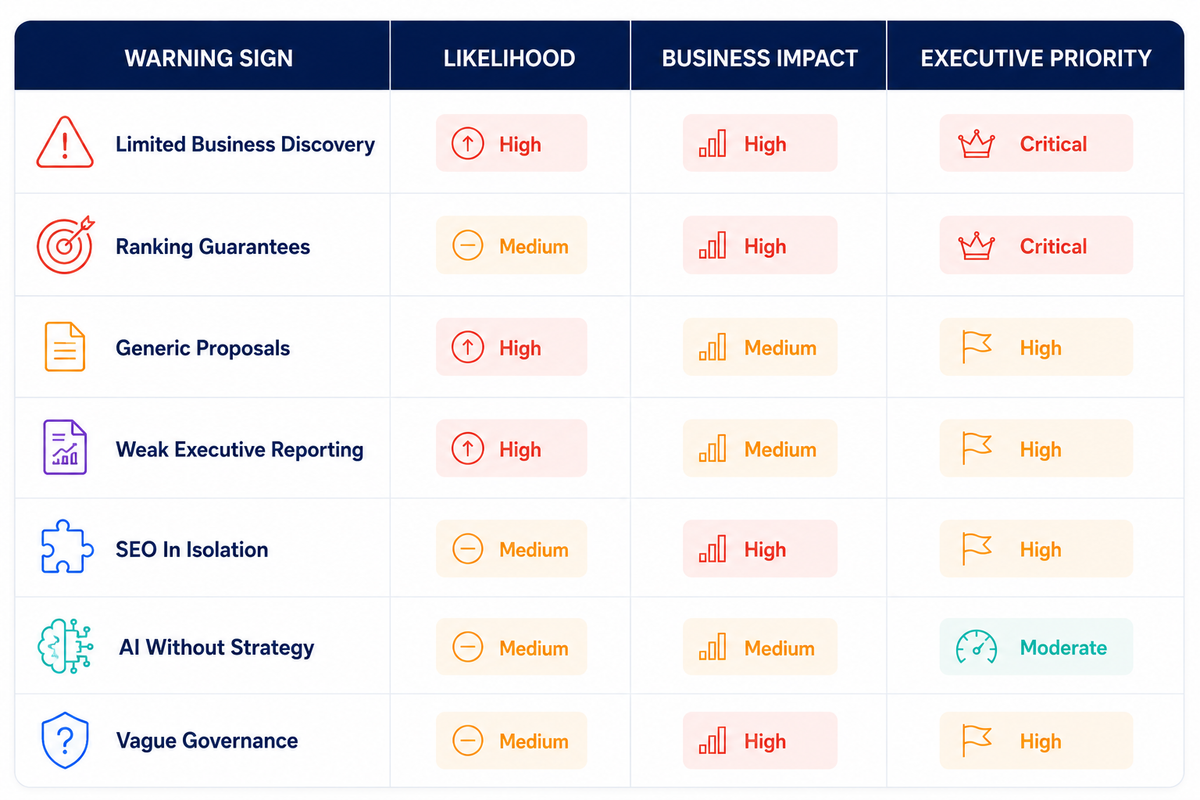
Executive Risk Assessment Matrix
Not every warning sign carries equal importance. Leadership should evaluate both likelihood and business impact.
This matrix should become part of every procurement discussion. Evaluating risk systematically is significantly more effective than relying on instinct.
Industry Perspective
Healthcare— An agency discussing only keyword rankings while ignoring patient trust, physician credibility, appointment experience, and local reputation demonstrates an incomplete understanding of healthcare marketing.
Law Firms — If a proposal focuses primarily on traffic without discussing consultation quality, case value, and competitive differentiation, leadership should investigate further. Legal marketing succeeds through authority—not volume alone.
Home Services — An HVAC contractor benefits more from one hundred qualified emergency calls than ten thousand informational visits. Commercial priorities should shape SEO strategy — not the reverse — a principle we apply directly in our Tree Service SEO and Pest Control SEO engagements.
Ecommerce— Traffic without profitable conversion creates operational cost rather than commercial value. SEO recommendations should align with merchandising, conversion optimization, and customer lifetime value.
Boardroom Discussion
Before selecting an agency, discuss these questions internally.
Which assumptions within this proposal concern us most?
What risks remain unexplored?
Which recommendations appear customized?
Which claims rely primarily on confidence rather than evidence?
Would we feel comfortable defending this procurement decision before our Board of Directors?
Executive confidence should increase throughout procurement—not decrease.
Executive Action
Create a formal "Red Flag Register."
For every shortlisted agency, document:
Strategic concerns.
Operational concerns.
Communication concerns.
Commercial concerns.
Implementation concerns.
Review this register before making any final decision. The agency with the fewest unresolved risks frequently becomes the strongest long-term partner—even if it was not the most persuasive presenter.
Executive Summary
Strong partnerships are rarely defined by impressive promises.
They are defined by disciplined thinking, transparent communication, realistic expectations, and continuous improvement.
Organizations that identify warning signs early protect not only their marketing investment but also their future competitive position.
Executive Quote
"Executive procurement is not about finding reasons to say yes. It is about identifying reasons to hesitate before expensive mistakes are made."
Chapter 7 — Why Industry Expertise Is a Competitive Advantage, Not a Marketing Claim
Executive Problem
One of the most common statements made by SEO agencies is:
"We work with businesses in every industry."
At first glance, this appears to be a strength.
Broad experience suggests adaptability.
Exposure to multiple industries implies a wider perspective.
Yet executive teams should pause before assuming that broad experience automatically translates into better commercial outcomes.
Search engines may use the same underlying principles across industries.
Customers do not.
The way a homeowner selects an HVAC contractor differs dramatically from how a corporate executive selects a cybersecurity consultant.
A patient evaluating a healthcare provider behaves differently from a consumer buying shoes online.
A business owner hiring a law firm does not make decisions the same way a family booking a vacation.
Each industry has its own:
Buying journey.
Trust signals.
Competitive pressures.
Definition of success.
Ignoring those differences produces generic SEO.
Understanding them produces business growth.
Evidence Brief
Across marketing and behavioral research, one conclusion appears consistently, echoed in research from Think with Google:
Customers do not purchase products or services because businesses publish more content.
They purchase when they develop sufficient confidence that one organization can solve their problem better than available alternatives.
Search visibility creates awareness. Trust influences evaluation. Business execution wins the customer.
SEO must therefore support every stage of that decision-making process rather than focusing exclusively on attracting visitors.
Why Generic SEO Strategies Fail
Many SEO campaigns begin with the same activities regardless of industry.
Keyword research.
Technical audits.
Content calendars.
Link-building initiatives.
Reporting dashboards.
These are important components of a campaign.
They are not the strategy.
A strategy explains:
Which customers matter most.
Which services generate the greatest profitability.
Which competitive advantages deserve greater visibility.
Which barriers prevent customers from choosing your business.
Which opportunities deserve executive attention first.
Without these answers, organizations often optimize for search engines instead of optimizing for markets.
Executive Analysis
Industry expertise should never be confused with industry familiarity.
Knowing industry terminology is useful.
Understanding industry economics is transformational.
Consider two agencies pitching the same financial advisory firm.
Which services generate the highest lifetime client value?
Which client segments create the strongest referrals?
What objections prevent prospects from scheduling consultations?
Which competitors consistently win executive trust?
How long is the average buying cycle?
Both agencies understand SEO.
Only one demonstrates an understanding of business.
That difference compounds throughout the engagement.
The Industry Alignment Framework
Before developing any SEO strategy, leadership should evaluate the relationship between business priorities and customer behavior.
Business Objectives
Customer Needs
Buying Journey
Trust Signals
Digital Experience
Search Strategy
Content Strategy
Conversion Strategy
Business Growth
Notice the sequence.
Search strategy appears after customer understanding.
Not before.
This is where many organizations unintentionally reverse the process.
They begin with keywords.
Market-leading organizations begin with customers.
Industry Perspectives
Healthcare
Patients rarely search only for symptoms. They evaluate:
Physician expertise.
Clinic reputation.
Patient reviews.
Appointment availability.
Insurance acceptance.
Accessibility.
Healthcare SEO therefore extends beyond rankings. It supports patient confidence.
Law Firms
Legal services involve significant personal and financial risk. Prospective clients evaluate:
Practice-area expertise.
Case experience.
Professional credibility.
Communication style.
Local reputation.
Authority matters as much as visibility — the core focus of our Law Firm SEO work.
Home Services
When a homeowner searches for an emergency plumber or HVAC technician, the buying journey is compressed. Decision factors include:
Availability.
Local proximity.
Review quality.
Response time.
Website clarity.
Ease of contacting the business.
Every minute of friction reduces conversion probability — the reason our Local SEO Services matter so much for this category.
Ecommerce
Successful Ecommerce SEO extends far beyond product rankings. Growth depends upon:
Category architecture.
Product discoverability.
Inventory visibility.
User experience.
Checkout simplicity.
Customer reviews.
Repeat purchasing.
Traffic is only the beginning of the customer journey.
B2B Professional Services
Complex B2B purchases involve multiple decision-makers. Buyers often consume significant educational content before contacting a provider. Thought leadership, industry expertise, executive credibility, and evidence of successful outcomes become essential trust signals. SEO supports this process by making expertise discoverable.
Executive Decision Matrix
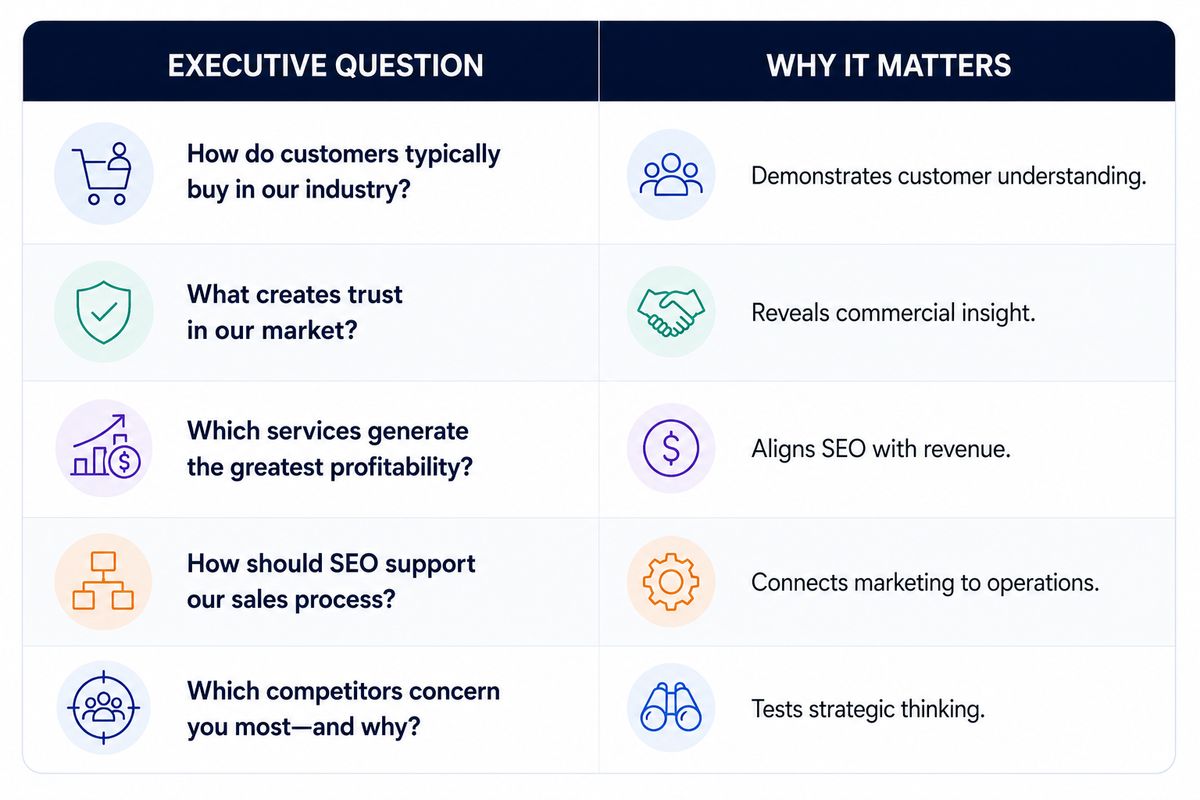
Evaluate whether an agency genuinely understands your industry by asking the following questions.
Strong agencies answer with business reasoning. Weak agencies answer with SEO terminology.
Boardroom Discussion
Before approving any SEO strategy, ask:
Does this strategy reflect how our customers actually make decisions?
Which trust signals influence buying behavior in our industry?
Are we optimizing for search engines or for customer confidence?
Which competitive advantage should become more visible?
How will this strategy support long-term revenue growth?
These discussions shift SEO from a tactical initiative to a business capability.
Executive Action
Develop an Industry Insight Brief before onboarding any agency.
The document should summarize:
Your ideal customer profile.
Your highest-margin services.
Your competitive advantages.
Common customer objections.
Buying journey stages.
Trust factors influencing purchase decisions.
Provide this brief before strategic planning begins. A better-informed agency makes better recommendations. This is a great starting point for a Custom SEO Strategy session with our team.
Executive Summary
SEO strategies succeed when they reflect how customers make decisions—not simply how search engines organize information.
Industry expertise is valuable because it enables agencies to connect search behavior with commercial behavior.
That connection transforms rankings into revenue.
Executive Quote
"The best SEO strategies are not built around keywords. They are built around customers, trust, and the economics of the business they are designed to grow."
Chapter 8 — The Anatomy of High-Performing SEO Partnerships
Executive Problem
Choosing an SEO agency is not the finish line.
It is the starting point.
Yet many organizations unconsciously treat the signing of the contract as the conclusion of the procurement process rather than the beginning of a long-term strategic partnership.
This mindset creates unrealistic expectations.
Leadership expects immediate results.
Marketing expects flawless execution.
Agencies expect client responsiveness.
Sales expects more qualified opportunities.
Operations expects minimal disruption.
When these expectations remain unspoken, even capable partnerships begin to weaken.
The most successful SEO engagements rarely succeed because one organization is exceptionally talented.
They succeed because both organizations operate as a unified growth team with shared objectives, disciplined communication, and mutual accountability.
The relationship—not simply the technical work—becomes the competitive advantage.
Evidence Brief
Research into high-performing professional service relationships, including insights from Bain & Company, consistently highlights several recurring characteristics:
Shared strategic objectives.
Clearly defined governance.
Regular executive communication.
Transparent measurement.
Continuous learning.
Mutual accountability.
Whether the engagement involves management consulting, technology implementation, legal advisory services, or digital marketing, long-term success depends less on isolated expertise and more on the quality of collaboration.
SEO is no exception.
Why Good Agencies Still Fail
It is tempting to assume unsuccessful SEO engagements result from poor technical execution.
In reality, many fail despite competent execution.
Consider a common scenario.
The agency publishes content.
Technical recommendations are delivered.
Website improvements are identified.
Reports are sent each month.
However:
Leadership rarely reviews performance.
Sales never shares lead quality feedback.
Developers prioritize other projects.
Marketing measures traffic.
Finance measures revenue.
Nobody measures the relationship itself.
Eventually both organizations become busy.
Communication becomes reactive.
Momentum slows.
Performance plateaus.
The problem was never SEO.
The problem was organizational alignment.
Executive Analysis
The highest-performing SEO partnerships behave much less like supplier relationships and much more like executive advisory relationships.
The agency becomes an extension of the leadership team.
It contributes market intelligence.
Challenges assumptions.
Identifies competitive threats.
Helps prioritize investment decisions.
Supports strategic planning.
Rather than simply completing monthly tasks, it influences how the organization thinks about growth.
This transformation does not happen automatically.
It is intentionally designed through governance, communication, and shared accountability.
The Growth Partnership Flywheel
Sustainable SEO performance is created through an ongoing cycle of learning and improvement rather than isolated campaigns.
Business Objectives
Executive Strategy
SEO Priorities
Technical & Content Execution
Customer Experience
Qualified Demand
Business Insights
Strategic Refinement
Business Objectives
Unlike traditional campaigns, this cycle never truly ends.
Every quarter generates new customer insights.
Every optimization creates new learning.
Every improvement informs the next strategic decision.
Competitive advantage compounds through repetition.
The Six Characteristics of High-Performing Partnerships
1. Shared Business Objectives
Exceptional agencies do not begin with rankings.
They begin with business goals.
Revenue.
Market expansion.
Customer acquisition.
Brand authority.
Operational efficiency.
Every SEO initiative supports one or more executive objectives.
2. Radical Transparency
Strong partnerships discuss problems early.
Missed opportunities.
Unexpected market changes.
Algorithm updates.
Implementation delays.
No surprises.
No hidden assumptions.
Trust grows through transparency—not perfection.
3. Continuous Prioritization
Every organization has limited resources.
High-performing partnerships continually ask:
"If we could complete only one initiative this month, which would create the greatest business impact?"
Prioritization creates leverage.
Activity creates busyness.
4. Cross-Functional Collaboration
SEO rarely succeeds in isolation.
Marketing creates demand.
Sales validates lead quality.
Developers improve website performance.
Customer service identifies recurring customer questions.
Leadership establishes priorities.
The strongest partnerships integrate every department contributing to customer acquisition.
5. Executive-Level Reporting
Operational reporting answers:
"What happened?"
Executive reporting answers:
"What should we do next?"
Leadership should leave quarterly reviews with greater strategic clarity—not simply more charts.
6. Continuous Learning
Markets change.
Competitors evolve.
Customer expectations shift.
AI continues developing.
High-performing partnerships learn continuously rather than defending outdated assumptions.
The willingness to change course intelligently often determines long-term success.
Industry Perspective
Healthcare — Leading healthcare organizations continuously refine patient education, appointment experiences, local visibility, and physician authority based on changing patient expectations. SEO becomes one component of broader patient acquisition strategy.
Construction & Home Services — Successful contractors regularly adjust strategies based on seasonality, labor capacity, geographic expansion, and changing service demand. The partnership evolves alongside the business, much like our ongoing Appliance Repair SEO and Kitchen Remodeler SEO engagements.
Ecommerce — Product launches, inventory changes, customer behavior, competitive pricing, and merchandising priorities all mean SEO must evolve continuously to remain commercially relevant.
B2B Services — Thought leadership, executive credibility, account-based marketing, and long sales cycles require sustained collaboration across marketing, sales, and leadership. High-performing agencies become strategic advisors rather than external vendors.
Executive Partnership Scorecard
Leadership should evaluate the relationship—not only SEO performance. Score each area quarterly.
Partnership Dimension
Strategic Alignment
Communication Quality
Business Understanding
Executive Reporting
Commercial Impact
Adaptability
Trust & Transparency
Continuous Improvement
If any category consistently scores below three, the partnership deserves executive attention before performance deteriorates.
Boardroom Discussion
Quarterly, ask your executive team:
Are our priorities becoming clearer?
Has decision-making improved?
Do we understand customers better today than six months ago?
Has the agency influenced strategy—not just execution?
Would we confidently choose this partner again today?
These questions measure relationship quality rather than campaign activity. Long-term partnerships are built on both.
Executive Action
Replace the traditional "Monthly SEO Meeting" with a Quarterly Executive Growth Review.
The agenda should include:
Business performance.
Competitive developments.
Customer insights.
Strategic priorities.
Emerging opportunities.
Executive decisions required.
Treat SEO as a business capability—not simply a marketing channel.
Executive Summary
Exceptional SEO partnerships are not defined by technical expertise alone.
They are defined by strategic alignment, disciplined communication, executive trust, and a shared commitment to continuous improvement.
The strongest agencies become trusted advisors.
The strongest clients become collaborative partners.
Together, they build capabilities that competitors cannot easily replicate.
Executive Quote
"The greatest value an SEO agency can create is not higher rankings. It is helping an organization make better growth decisions year after year."
Chapter 9 — How to Compare SEO Proposals Like an Executive
Executive Problem
By the time an organization reaches the proposal stage, months of work have often been completed.
Internal meetings have been held.
Budgets have been approved.
Stakeholders have aligned around strategic priorities.
Agencies have invested significant effort preparing recommendations.
The leadership team now faces what appears to be a straightforward decision.
Choose the best proposal.
Yet this is where many organizations make their biggest mistake.
They compare proposals instead of comparing strategic capability.
A proposal is a document.
Capability is an organization's ability to consistently solve business problems.
The two are related.
They are not the same.
An attractive presentation can create confidence.
Only disciplined execution creates long-term business value.
The executive team's responsibility is therefore not to select the best-looking proposal.
It is to identify the partner most capable of strengthening the business over the next three to five years.
Evidence Brief
Strategic procurement methodologies, similar to those described by Deloitte Insights, consistently recommend evaluating vendors using weighted decision criteria rather than relying primarily on pricing or subjective impressions.
This approach reduces cognitive bias, improves stakeholder alignment, and creates more consistent long-term procurement outcomes.
The same principle applies when evaluating SEO agencies.
A structured decision framework consistently outperforms intuition.
Why Proposal Comparisons Often Fail
Most organizations compare proposals horizontally.
Agency A offers:
12 blog articles.
Monthly reporting.
Technical audits.
Link building.
Agency B offers:
8 articles.
Quarterly strategy workshops.
CRO recommendations.
Technical implementation.
Agency C offers:
Unlimited revisions.
Daily rank tracking.
AI-generated content.
Lower monthly pricing.
Leadership begins comparing deliverables.
The discussion quickly becomes tactical.
The strategic question disappears.
Instead of asking, "Which organization understands our business best?" the conversation becomes, "Which proposal includes more services?"
Quantity replaces quality.
Activity replaces strategy.
This is the wrong comparison.
Executive Analysis
A proposal should never be evaluated as a list of services.
It should be evaluated as evidence of thinking.
Every recommendation reveals something about the agency.
How it prioritizes.
How it understands markets.
How it manages uncertainty.
How it approaches customer acquisition.
How it defines success.
An executive team should leave every proposal presentation with one question answered:
"How does this agency think?"
If leadership cannot explain the agency's strategic reasoning after the meeting, the proposal has failed regardless of how impressive the presentation appeared.
The Executive Proposal Evaluation Matrix
Every proposal should be scored across five dimensions.
Dimension 1 — Business Understanding (25%)
Does the proposal demonstrate a genuine understanding of:
Your business model?
Your customers?
Your competitive landscape?
Your commercial priorities?
Look for business insight before SEO recommendations.
Would we trust this agency during an economic downturn?
Would we invite them into strategic planning discussions?
Would we confidently recommend them to another executive?
Trust is difficult to measure. Yet it is often the strongest predictor of long-term success.
Executive Proposal Scorecard
Complete the scorecard individually before discussing results as a leadership team. Independent scoring reduces groupthink and surfaces meaningful differences in perspective.
Executive Scenario
Imagine three agencies submit proposals.
Agency A offers the lowest monthly retainer.
Agency B presents the most polished slides.
Agency C asks the most difficult questions.
Six months later, which agency is most likely to improve your business?
In many cases, the answer is Agency C.
Not because its proposal looked better.
Because it demonstrated curiosity, strategic thinking, and a willingness to challenge assumptions.
Organizations rarely grow through comfortable conversations.
They grow through better decisions.
Industry Perspective
Healthcare — A proposal should discuss patient acquisition, reputation management, local visibility, and appointment conversion—not simply keyword opportunities.
Financial Services — Look for evidence that the agency understands trust, compliance, educational content, and long sales cycles.
Ecommerce — Evaluate how recommendations support:
Revenue growth.
Product discovery.
Conversion optimization.
Customer lifetime value.
Not merely traffic acquisition.
Professional Services — Authority, thought leadership, executive credibility, and referral amplification often create greater long-term value than incremental ranking improvements.
Boardroom Discussion
Before selecting a partner, ask your leadership team:
Which proposal best understands our business?
Which agency challenged our assumptions?
Which recommendations are most likely to improve competitive position?
Which organization would we trust with a three-year partnership?
If pricing were removed entirely, which agency would we choose?
The final question often produces the clearest answer.
Executive Action
Before signing any agreement, request a final strategy session with your preferred agency.
Do not discuss pricing.
Instead, ask them to walk through:
Their first ninety days.
The assumptions supporting the strategy.
The biggest implementation risks.
How success will be measured.
How leadership should participate.
If those answers increase executive confidence, pricing becomes a commercial negotiation rather than a strategic uncertainty. You can also Talk to an SEO Strategist directly to see how this process works in practice.
Executive Summary
Exceptional procurement decisions are rarely made by comparing services.
They are made by comparing strategic capability.
The strongest proposal is not necessarily the most detailed.
It is the one that demonstrates the clearest understanding of your business, the strongest strategic reasoning, and the highest probability of creating sustained commercial value.
Executive Quote
"Every proposal answers two questions. What will the agency do? More importantly, how does the agency think? Executive teams should place greater weight on the second answer than the first."
Chapter 10 — Making the Decision: Choosing an SEO Partner That Creates Long-Term Competitive Advantage
Executive Problem
Every strategic investment eventually arrives at the same moment.
The analysis is complete.
The presentations have ended.
The scorecards have been reviewed.
Leadership has debated the alternatives.
The time for discussion is over.
A decision must be made.
Ironically, this is often where executive teams become least objective.
Weeks of analysis suddenly give way to intuition.
Someone prefers the agency that "felt right." Someone else prefers the lowest proposal. Another stakeholder recommends the agency with the most recognizable client logos.
These instincts are understandable.
They are also precisely why structured procurement exists.
The purpose of a decision framework is not to eliminate judgment.
It is to ensure judgment is informed by evidence rather than influenced by presentation quality, personal preference, or short-term cost.
The final decision should answer one question—and one question only:
Which agency gives our organization the highest probability of becoming more competitive over the next three to five years?
Everything else is secondary.
Evidence Brief
Studies in strategic procurement consistently show that organizations create better long-term outcomes when vendor selection aligns with organizational objectives rather than short-term financial considerations alone.
In professional services, the value created over the life of the relationship often exceeds the initial differences in pricing.
A lower-cost engagement that produces limited business value is ultimately more expensive than a higher-value partnership that accelerates sustainable growth.
Leadership should therefore evaluate total business impact—not monthly retainers.
The Executive Decision Principle
One of the most common misconceptions surrounding SEO procurement is that leadership is purchasing search engine optimization.
It isn't.
Leadership is investing in a business capability.
That capability influences:
Brand visibility.
Customer acquisition.
Market authority.
Website performance.
Buyer confidence.
Competitive positioning.
Long-term revenue generation.
Viewing SEO through this broader lens fundamentally changes procurement.
Instead of asking, "Which agency offers more deliverables?" executive teams ask, "Which organization is most capable of strengthening our business?"
This shift represents the central argument of this publication.
Executive Analysis
Throughout this guide we have explored ten interconnected ideas. Each builds upon the previous chapter. Together they form a complete executive decision framework.
We began by recognizing:
The greatest cost of hiring the wrong agency is not financial. It is lost competitive opportunity.
We then established:
Traditional SEO metrics should support executive decisions rather than replace them. Business outcomes matter more than marketing activity.
We explored:
Artificial intelligence is changing search interfaces. It is not changing the importance of expertise, trust, and customer value.
We developed:
A structured evaluation framework for comparing agencies objectively.
We introduced:
A disciplined due diligence process that reduces procurement risk.
We identified:
The warning signs that consistently predict unsuccessful partnerships.
We demonstrated:
Why industry understanding frequently matters more than technical specialization.
We examined:
The characteristics shared by high-performing agency relationships.
We created:
A proposal evaluation methodology that places strategic capability above presentation quality.
Collectively, these principles lead to one conclusion.
Organizations that consistently outperform competitors do not simply hire better agencies.
They make better executive decisions.
The Executive Decision Framework
Before signing an agreement, leadership should answer these five questions with complete confidence.
1. Does this agency understand our business better than our competitors do?
Business understanding always precedes effective execution.
2. Does the proposed strategy solve our most important commercial challenge?
SEO should support business strategy. Not become the strategy.
3. Will this partnership strengthen our organization two years from now?
Think beyond rankings. Think about organizational capability, customer understanding, market authority, and executive decision-making.
4. Would we still choose this agency if pricing were identical?
If the answer is no, pricing is driving the decision more than strategic confidence.
5. Would we proudly defend this decision one year from today?
If leadership cannot answer yes today, additional evaluation is warranted.
Executive Decision Matrix
Use this final matrix before approving any agency.
If several responses remain uncertain, postpone the decision. Procurement should increase executive confidence—not reduce it.
Industry Perspective
Although this guide has referenced healthcare, legal services, financial services, ecommerce, home services, construction, and professional services throughout, one conclusion applies universally. It applies just as much to a growing Real Estate SEO brand as it does to a regional Travel SEO operator, a Hospitality SEO group, or an Education SEO institution.
Organizations do not achieve sustainable digital growth because they purchased more SEO.
They achieve sustainable growth because they consistently invested in understanding customers, improving digital experiences, demonstrating expertise, and making disciplined business decisions.
SEO amplifies those strengths.
It cannot compensate for their absence.
Boardroom Discussion
Before approving the final contract, ask every executive in the room one final question:
"Imagine we are sitting here three years from today. Looking back, what would have made this partnership an undeniable success?"
Write every answer on the board.
Those responses become the true success criteria for the engagement.
Not rankings.
Not reports.
Not deliverables.
Business outcomes.
Executive Action
Conduct a formal Executive Alignment Session before signing.
Participants should include:
CEO or Founder.
Marketing Leadership.
Sales Leadership.
Operations.
Agency Leadership.
The meeting should conclude with a shared understanding of:
Strategic objectives.
Success metrics.
Communication cadence.
Decision-making responsibilities.
First-year priorities.
Long-term vision.
The strongest partnerships begin with organizational alignment—not contractual obligation.
Executive Summary
Selecting an SEO agency is one of the few marketing decisions capable of influencing every stage of the customer acquisition journey.
Treat it accordingly.
The objective is not to purchase deliverables.
It is to invest in an organization that strengthens your ability to compete, earn trust, attract customers, and create sustainable growth.
The right partnership compounds.
So does the wrong one.
Leadership's responsibility is to ensure the organization chooses wisely.
Executive Quote
"Businesses rarely become market leaders because they found a better SEO agency. They become market leaders because they consistently made better strategic decisions than their competitors."
Conclusion — The Future Belongs to Businesses That Build Digital Authority
When executives evaluate an SEO agency, they often believe they are making a marketing decision.
In reality, they are making a business decision.
The partner they select will influence how their company is discovered, evaluated, trusted, and chosen in an increasingly digital economy.
That influence extends far beyond search rankings.
It affects:
Customer acquisition.
Brand credibility.
Competitive positioning.
Revenue growth.
Long-term enterprise value.
Throughout this guide, we have deliberately challenged many of the assumptions that have shaped SEO procurement for the past decade.
We argued that rankings are not the objective.
Traffic is not the objective.
Publishing more content is not the objective.
The real objective is building an organization that customers consistently trust and search engines consistently recognize as authoritative.
That distinction changes everything.
Instead of evaluating agencies by the quantity of work they promise, leadership begins evaluating them by the quality of thinking they demonstrate.
Instead of rewarding activity, organizations reward impact.
Instead of chasing algorithm updates, they invest in enduring competitive capabilities.
Artificial intelligence will continue changing how people discover information.
Search interfaces will continue evolving.
Consumer expectations will continue rising.
None of these trends reduce the importance of expertise.
None reduce the importance of trust.
None reduce the importance of exceptional customer experiences.
If anything, they amplify them.
Businesses that consistently educate their markets, solve customer problems, communicate with clarity, and improve their digital experiences will continue earning visibility regardless of how search technology evolves.
Technology changes.
Business fundamentals endure.
That is the central message of this publication.
The question facing every executive team is therefore not:
"Which agency can improve our rankings?"
It is:
"Which partner will help us build the strongest digital business over the next five years?"
Organizations that answer that question well will not simply generate more traffic.
They will create:
Stronger brands.
Better customer relationships.
Higher-quality demand.
Greater resilience.
A competitive advantage that compounds year after year.
Executive Takeaways
If your leadership team remembers only ten ideas from this guide, they should be these:
SEO is a strategic business capability—not simply a marketing service.
The greatest cost of hiring the wrong agency is lost competitive opportunity.
Rankings are indicators—not business outcomes.
Artificial intelligence changes interfaces, not the importance of trust and expertise.
Business understanding should always precede SEO recommendations.
Industry context matters as much as technical capability.
Strong partnerships are built on governance, transparency, and shared accountability.
Executive reporting should improve decisions—not merely describe activity.
The best proposal demonstrates superior thinking, not the largest list of deliverables.
Long-term digital authority is one of the most valuable competitive assets a modern business can build.
Executive Checklist
Before signing with any SEO agency, confirm that your organization can answer "Yes" to each of the following questions.
Strategy
Have we clearly defined the business problem SEO should solve?
Do we understand our most profitable customer segments?
Have we identified our biggest growth constraint?
Procurement
Have we evaluated agencies using consistent strategic criteria?
Have we discussed risks and assumptions openly?
Have we compared strategic capability rather than pricing alone?
Partnership
Are executive KPIs documented?
Are implementation responsibilities clearly defined?
Does leadership trust the agency's judgment?
Have we agreed on how success will be measured?
If any answer is No, continue the evaluation process before signing a long-term agreement.
Recommended Reading
Leadership teams seeking to deepen their understanding of digital growth should regularly follow research and guidance from:
McKinsey & Company insights on digital transformation and growth strategy.
Bain & Company research on customer loyalty, competitive differentiation, and value creation.
Deloitte Insights publications covering digital experience, technology strategy, and executive leadership.
Readers are encouraged to consult the original publications for the most current recommendations and research findings.
About Ophanim Technologies
Ophanim Technologies partners with growth-focused organizations across the United States and Canada to help them strengthen their digital presence through strategic SEO, AI-informed search strategies, high-performing websites, conversion rate optimization, paid media, and long-term digital growth consulting.
Rather than measuring success by rankings alone, Ophanim Technologies focuses on the business outcomes that matter most to executive teams:
Qualified lead generation.
Consultation bookings.
Revenue growth.
Market authority.
Sustainable competitive advantage.
The company's philosophy is simple:
Marketing should strengthen the business—not simply increase marketing activity.
Every executive eventually faces the same decision.
Continue investing in disconnected marketing activities.
Or begin building a digital growth system designed to create lasting competitive advantage.
Before choosing your next SEO partner, ask one question:
"Will this agency make our business stronger—or simply keep us busier?"
The answer may become one of the most important strategic decisions your leadership team makes this decade.
"The future will not belong to the businesses with the most content, the most keywords, or the largest marketing budgets. It will belong to the organizations that earn trust, demonstrate expertise, and consistently create value for the customers they serve."
Frequently Asked Questions
Find clear answers to the questions we hear most often.