Marketers know how valuable AI technology can be for creating content, but will AI technology be enough to create successful SEO for 2026? Probably not. The real optimal content for SEO comes from combining AI's rapid results with the human touch to create content that is reliable, interesting, and helpful.
Over the years, search engines have continuously evolved to better understand what users are looking for, and now they are much more capable of sorting content that does and does not meet quality standards. AI is a really useful tool that can speed up the research and optimization process, but without the supervision of humans, AI-generated content is unreliable.
This guide outlines a practical SEO content creation workflow that leverages AI at every stage while keeping people — not algorithms — at the center of the process.
Step 1: Start with Search Intent, Not Just Keywords
Before generating a single paragraph, determine what users actually want when they search for a topic.
Ask questions like:
- What problem is the user trying to solve?
- Are they looking for information, comparisons, or a product?
- What are they most likely going to ask after this?
AI tools can quickly analyze search results, identify common themes, and suggest related questions, helping you build content that addresses the full user journey rather than targeting a single keyword.
Goal: Create content that directly answers the user's needs.
Step 2: Conduct Comprehensive Keyword and Topic Research
Traditional keyword research has evolved into topic research.
Instead of focusing on one primary keyword, identify:
- Main focus keywords
- Extended focus keywords
- Affiliate marketing keywords
- Common queries
- Contextual keywords
- Keywords that are missing
- Rival subjects
AI can organize these insights into topic clusters, making it easier to build comprehensive content that covers a subject from multiple angles.
Example
Primary Topic: SEO Content Workflow
Supporting Topics:
- AI content research
- Keyword clustering
- Search intent
- E-E-A-T
- Content optimization
- Internal linking
- Content updates
Step 3: Build a Content Outline
A well-structured outline improves both readability and SEO.
Instead of asking AI to generate a full article immediately, use it to create the following:
- H1 title
- H2 sections
- H3 subtopics
- FAQs
- Key takeaways
- Content flow
Review the outline manually to ensure it matches your audience's expectations and covers the topic thoroughly.
Why it matters: A clear structure helps readers navigate the content while making it easier for search engines to understand your page.
Step 4: Create the First Draft with AI
Once the outline is finalized, AI can generate a strong first draft quickly. However, don't publish AI-generated content without editing.
Use AI for:
- Explaining concepts
- Expanding ideas
- Creating examples
- Drafting introductions
- Suggesting transitions
- Writing summaries
Think of AI as your writing assistant — not your editor-in-chief.
Step 5: Add Human Expertise and Original Value
This is where your content can shine.
Augment the draft with:
- Original thought processes
- Knowledge of the field
- Primary example types
- First-hand participation
- Original data
- Research statistics
- Diagrams
- Professional viewpoint
- Practical tips
Adding unique value demonstrates experience and expertise, which are increasingly important signals for search visibility.
Step 6: On-Page SEO
After improving the content, further enhancements can be made for readability using on-page search engine optimization.
The main considerations when finalizing content are:
- A compelling title tag that attracts clicks and improves search visibility
- A well-worded meta description
- Well-structured headings (H1, H2, H3, etc.)
- Natural, easy-going keyword insertion
- Connections to internal pages
- Connections to external pages citing leading sources
- Alt text for images
- Descriptive URLs
- Schema markup where appropriate
Optimization should support the reader — not interrupt the reading experience.
Step 7: Improve Readability and User Experience
Excellent content is easy to consume. Before publishing, check for:
- Shorter paragraphs — keep paragraphs short
- Headings — use descriptive headings
- Bullet points — use them when appropriate
- Visuals — use diagrams and other visuals
- Highlights — use plenty of highlights
- Mobile-friendly — make sure pages look good on a mobile device
- Speed — make pages load as quickly as possible
A better reading experience often leads to longer engagement and higher user satisfaction.
Step 8: Review Everything
AI is a powerful tool, but it's not always perfect. It may sometimes give outdated information, incorrect details, or examples that don't accurately reflect the topic. Check every important claim and make sure it is reliable and relevant before you publish your content.
Here's what you should check:
- Relevancy — ensure the information directly supports your topic and matches the user's search intent
- Timeliness — check that the content is up to date, especially when referencing statistics, trends, tools, or industry practices
- Precision — make sure examples are precise and clearly illustrate the concepts you're explaining
- Validity — confirm that all information is valid by cross-checking it with trusted, authoritative sources
A thorough fact-check not only improves the accuracy of your content but also builds credibility with readers and helps establish long-term trust with search engines.
When you do it right, readers trust you, and search engines rank you higher for longer.
Step 9: Publish and Promote
Publishing only marks the start of your effort.
Make your content more visible by distributing it in multiple ways:
- Social media
- Email
- Online communities
- Professional connections
- Helpful blog posts
Repurpose your article into videos, infographics, carousels, or short-form posts to extend its reach.
Step 10: Track Performance and Make Updates
Your SEO content will need revisions over time.
Monitor the following:
- Organic traffic
- Keyword rankings
- Click-through rate (CTR)
- Average engagement time
- Bounce rate
- Conversions
Refresh your content periodically by:
- Adding new examples
- Updating screenshots
- Including recent trends
- Expanding sections
- Improving internal links
Keeping content current helps maintain its relevance and competitiveness.
The AI-Powered SEO Content Workflow at a Glance
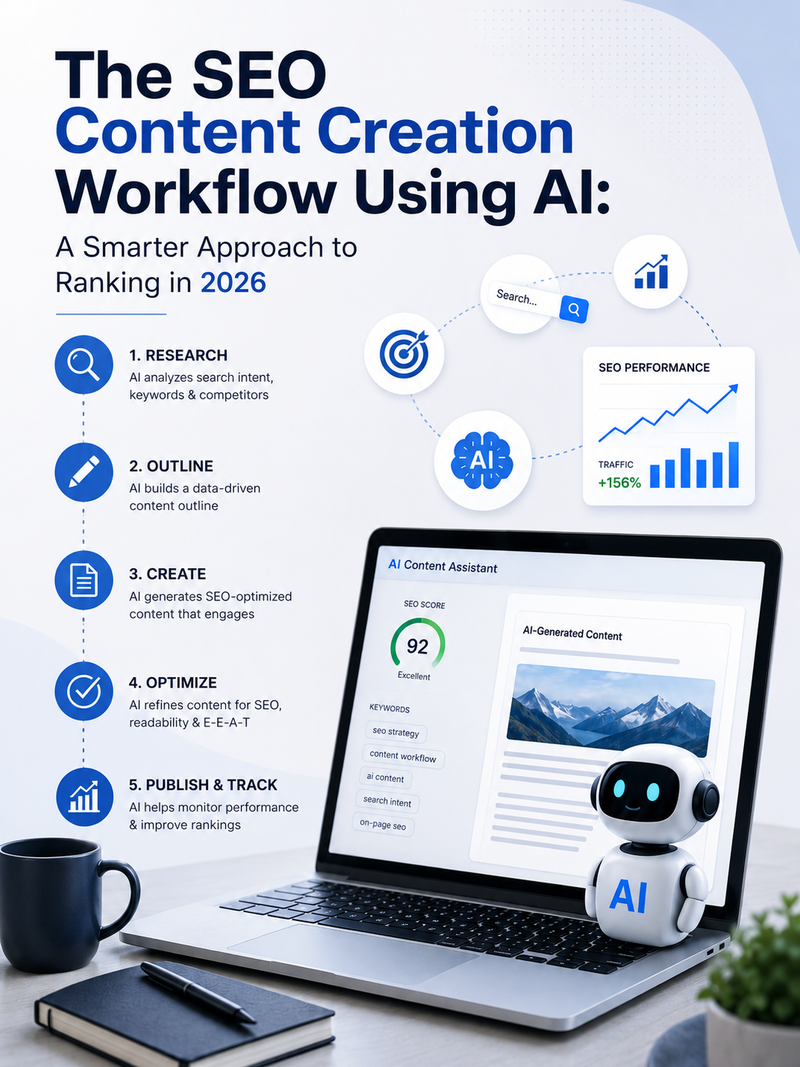
- Understand search intent.
- Research keywords and topics.
- Draft an accelerated outline.
- Choose the best AI content generation option for your needs.
- Make the content usable, readable, and accurate — add your own insight and polish it to perfection by removing common AI-generated tells (especially in first-try drafts). Scan for generic AI phrasing, awkward wording, and overly formal sentences that haven't yet been reviewed by a real person. The goal is a comprehensive resource that genuinely answers users' questions.
- Enhance on-page SEO.
- Release and share.
- Track results and make improvements often.
Best Practices for AI-Assisted SEO Content in 2026
- Use AI to accelerate research and drafting, but rely on human expertise for final content.
- Focus on solving real user problems instead of simply targeting keywords.
- Build topical authority with interconnected content.
- Demonstrate experience through original examples and practical insights.
- Keep content accurate, up-to-date, and easy to navigate.
- Regularly review and improve existing articles based on performance data.
Conclusion
AI will continue to help SEO with content creation. Integrating AI content creation systems into your process will be your competitive advantage. The best content of 2026 won't be made by AI alone but through an integrated, collaborative process that includes research, planning, good writing, optimization, and edits — with AI supporting each stage. SEO will not only support rankings but will also help establish credibility with an audience.