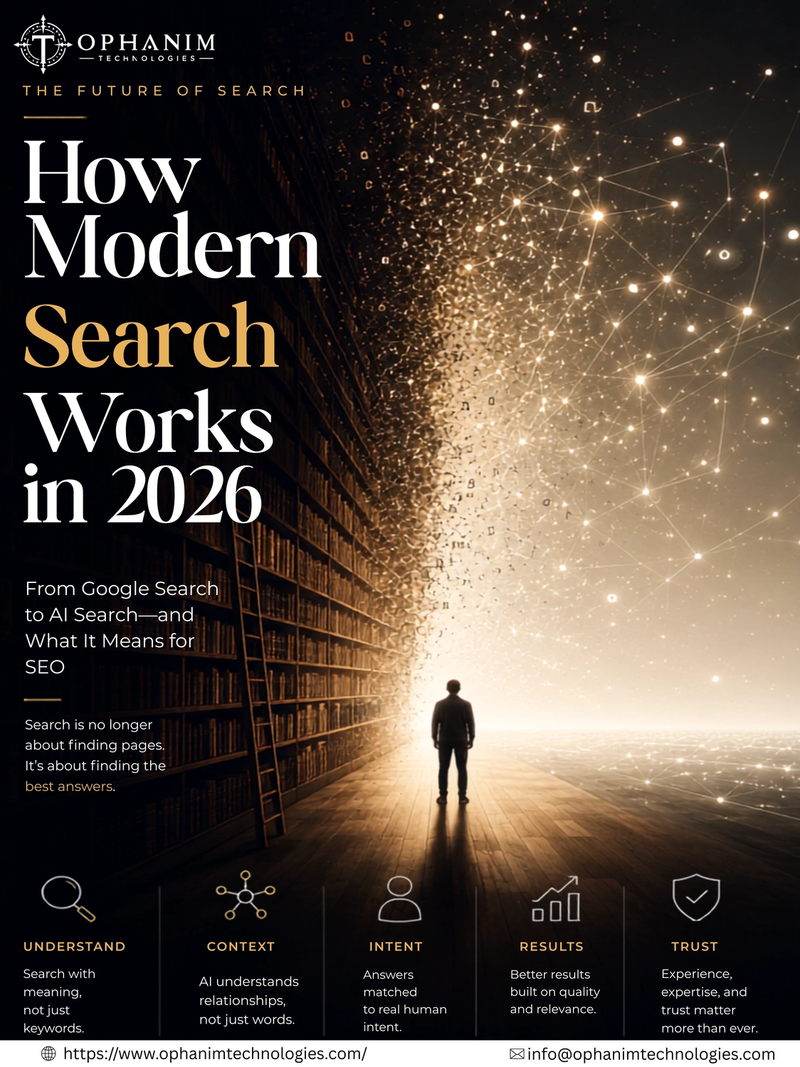
Search Is No Longer About Finding Pages—It Is About Finding the Best Answers
Introduction
For years, Search Engine Optimization (SEO) followed a relatively straightforward formula. Research the right keywords, optimize your page titles, earn backlinks, and improve your rankings on Google. While those practices still play an important role, they no longer represent the complete picture of modern search.
The way the general public searches for information has changed drastically. The public is now more likely to type a longer, more complete question, expecting a follow-up answer or even a conversation. Many people now use several different websites to research and reach an informed decision. In the buyer's journey, researching starts with a Google search and then continues with a general review of AI. After that, the buyer will use ChatGPT for a more detailed request or explanation, followed by a YouTube video for an informative demonstration, and then finally conclude with a visit to the official website of the company from which they plan to purchase.
Search is no longer a single destination. It has become an interconnected ecosystem of search engines, AI assistants, knowledge bases, videos, forums, and websites. At the same time, search engines themselves have become dramatically more sophisticated. Rather than simply matching webpages with keywords, modern search systems attempt to understand language, user intent, relationships between concepts, and the overall credibility of information.
Although generative AI is relatively new to the mainstream, the evolution of understanding and how it has impacted the industry has been in the works for a long time, and AI, particularly the technologies that leverage AI, has catalyzed the transformation.
SEO has dramatically evolved, and the requirements for success have changed fundamentally. Modern SEO is no longer about persuading an algorithm to rank your webpage. It is about creating information that is genuinely helpful, technically accessible, contextually relevant, and trustworthy enough to deserve visibility wherever people search for answers.
Even when displayed as conventional search results, AI-generated summaries, featured snippets, knowledge panels, or conversational responses, there is a notable consistency in what is attempted:
Deliver the most reliable information to the right person at the right moment.
Understanding how modern search works is the foundation for building sustainable visibility in this new era.
Advancement of Search: Comprehending Instead of Searching Keywords
The internet of the late 1990s looked very different from today's web. Search engines were designed to solve a relatively simple problem: help people find webpages containing the words they searched for.
If a user searched for the phrase "best running shoes," the search engine would try to find web pages that contain those terms verbatim. Unfortunately, web pages that contained those terms and discussed them more often were ranked as more relevant than web pages with higher content quality.
As the web expanded, this approach became increasingly unreliable. Website owners quickly learned how to manipulate rankings through keyword stuffing, hidden text, doorway pages, duplicate content, and countless other tactics that optimized for algorithms instead of users.
Search quality declined. To improve results, search engines needed to evolve. Instead of asking:
"Does this page contain the keyword?"
They began asking a much more important question:
"Does this page actually answer the user's question?"
That one change permanently altered SEO. Currently, search engines analyze:
- the meaning behind a query
- the user's intent
- relationships between concepts
- the quality of available information
- and which result is most likely to solve the user's problem
Modern SEO is no longer a discipline built around keywords alone. It is a discipline built around understanding.
Search Doesn't Search the Internet
One of the biggest misconceptions about Google is that it searches the live internet every time someone performs a search. It doesn't.
Imagine walking into a large public library. When you ask the librarian for a book, they don't leave the building to search every bookstore in the world. Instead, they consult an organized catalog that has already been created. Google works in much the same way.
Long before a user performs a search, Google has already spent enormous computing resources discovering webpages, downloading them, processing their content, and storing relevant information inside a massive searchable index.
When someone searches, Google primarily searches that index—not the live web. This distinction is important because a webpage cannot appear in search results unless Google has already discovered, processed, and indexed it.
Here's a simplified version of a search pipeline:
Website Published → Discovery → Crawling → Rendering → Indexing → Retrieval → Ranking → Search Results
Every stage depends on the one before it. If Google cannot discover your webpage, it cannot crawl it. If it cannot crawl it, it cannot render it. If it cannot render it correctly, it may never be indexed. And if it is not indexed, it cannot rank—regardless of how valuable the content might be. Understanding this pipeline explains why great SEO begins long before rankings are calculated.
Crawling: How Search Engines Discover the Web
Every webpage that appears in search results begins with discovery. Search engines use automated software—known as crawlers or bots—to explore the web continuously. Google's crawler, Googlebot, follows hyperlinks from one webpage to another, constantly discovering new pages while revisiting existing ones.
New pages are typically discovered through:
A useful way to visualize this process is to imagine Googlebot traveling across an enormous network of roads.
Every hyperlink acts like another road leading to additional destinations. The better connected your website is, the easier it becomes for search engines to discover your content efficiently.
This is why internal linking plays such an important role in technical SEO. Search engines have much greater difficulty finding and crawling pages that have no internal links pointing to them (i.e., orphan pages).
Website architecture, navigation, and internal links are therefore not only user experience considerations; they are also discovery mechanisms. Discovery is not enough on its own for visibility. Establishing a page is only the first stage.
Rendering: Understanding What Users Actually See
Modern websites are no longer built entirely from static HTML. Many rely on JavaScript frameworks such as React, Vue, Angular, or Next.js to generate portions of the page after it loads.
For visitors, this process usually happens almost instantly. For search engines, however, it introduces another stage. Before Google can fully understand many modern webpages, it must render them. Rendering is similar to loading the webpage inside a browser.
Instead of reading only the raw HTML, Google processes CSS, executes JavaScript where necessary, loads supporting resources, and constructs the final Document Object Model (DOM)—the version of the page users actually experience.
Google can only assess the following:
- headings
- visible content
- images
- navigation
- structured data
- and interactive elements
Rendering explains why technical SEO remains essential even in an AI-driven world. If critical information fails to load correctly, search engines may never fully understand what the page contains.
Modern frameworks have improved considerably through server-side rendering, static site generation, and hybrid rendering techniques, but ensuring that important content remains accessible is still a key technical responsibility. Good technical implementation makes understanding easier.
Indexing: Earning a Place in Google's Search Library
Many website owners assume that once Google visits a page, it automatically becomes searchable. That isn't always the case. After crawling and rendering, Google evaluates whether a page deserves inclusion within its search index. Indexing is not automatic. It is a quality decision.
Google considers factors such as uniqueness, usefulness, accessibility, and technical quality before deciding whether to store a page for future searches. Pages may fail to be indexed because of:
- duplicate content
- incorrect canonical tags
- noindex directives
- rendering issues
- server errors
- thin content
- or other quality concerns
This explains one of the most common SEO questions:
"Google crawled my page; why isn't it ranking?"
The most likely issue is that the page did not reach the indexing phase. Crawling, rendering, indexing, and ranking are four different tasks done by Google. Before a page can be ranked, it needs to pass each of these tasks successfully.
Search Understands Meaning—Not Just Keywords
One of the most important advances in modern search has been the move from keyword matching to semantic understanding.
Consider the word "Jaguar." Without context, it could refer to:
- the animal
- the luxury car manufacturer
- a software product
- or several other entities
In context, one can understand the implied meaning. Modern search engines increasingly do the same.
If someone searches for "Jaguar electric SUV price," Google understands that the user is almost certainly referring to the automobile manufacturer rather than the animal.
This capability is made possible through semantic search and entity understanding. Instead of viewing webpages as collections of isolated keywords, search engines increasingly interpret them as collections of connected ideas and real-world entities.
For content creators, this changes everything. Rather than repeating a keyword dozens of times, successful content explains a subject comprehensively, defines important concepts, answers related questions, and demonstrates genuine expertise.
Search has become less about repetition and far more about understanding.
Understanding Search Intent
Every search begins with a need—even when that need isn't explicitly stated. Someone searching for "best CRM software" is solving a very different problem from someone searching for "HubSpot pricing." The first user is exploring options. The second is much closer to making a purchasing decision.
Modern search engines attempt to recognize these differences because the most helpful answer depends on understanding the user's objective.
Traditionally, search intent is grouped into four categories:
- Informational
- Navigational
- Commercial Investigation
- Transactional
These categories remain useful, but real customer journeys are rarely linear. A buyer may start their purchase process by educating themselves about a topic, analyzing different solutions, reading reviews, assessing costs, and then going ahead with the purchase.
Companies that produce content that caters to all stages of the buyer's journey build a stronger level of trust when compared with companies that produce content only for the end buyer's journey keywords.
Ultimately, successful SEO is not about attracting the largest amount of traffic. It is about helping users move from curiosity to confidence.
Moving Beyond the Foundations
Everything we've explored so far explains how modern search works. Search engines discover webpages, process them, interpret their meaning, and attempt to understand the intent behind every query. These systems have become remarkably effective at organizing information—but understanding information is only part of the challenge.
The next question is even more important:
How do search engines decide which sources deserve to be trusted?
To address that question, we should consider E-E-A-T, topical authority, content quality, and the rising prominence of AI-based search experiences. These principles form the foundation of sustainable SEO in 2026 and beyond.
How Search Engines Decide What to Trust—and Why AI Changes Visibility, Not the Fundamentals
The mechanics of search explain how information is discovered, processed, and organized. But being indexed is only the beginning. Every search engine still faces the same challenge:
Out of millions of possible pages, which ones deserve to be shown first?
Answering that question requires much more than matching keywords or understanding language. Modern search systems evaluate credibility, expertise, usefulness, and overall information quality before deciding which content deserves visibility.
This is where the next generation of SEO begins.
Trust: The Foundation of Modern Search
Search engines exist to help users make informed decisions.
Researching a medical ailment. Comparing accounting software. Planning vacations. Tailoring custom suits. People rely on accurate, high-quality information. If search engines keep providing inaccurate and low-quality information, users will lose trust in the search platform.
Trust, therefore, has become one of the most important principles in modern search.
Contrary to popular belief, Google has never publicly confirmed the existence of a single "trust score" assigned to websites. Instead, trust emerges from the combination of many different quality signals that help search systems estimate whether a page is likely to be accurate, helpful, and reliable.
These signals include technical quality, content depth, author expertise, website reputation, consistency, and user experience.
Rather than looking for one perfect metric, modern search evaluates whether a website repeatedly demonstrates qualities that make it worthy of recommendation.
Trust is not something a website claims. It is something it earns over time.
Understanding E-E-A-T
One of the most discussed concepts in modern SEO is E-E-A-T, which stands for:
- Experience
- Expertise
- Authoritativeness
- Trustworthiness
These principles come from the Google Search Quality Rater Guidelines. These guidelines help human quality raters evaluate the quality of search results. These principles are not a direct ranking algorithm; rather, they illustrate the characteristics of high-quality content.
Knowledge of E-E-A-T can provide insight into websites that continually perform well and those that have difficulty building an established audience.
Experience
Experience refers to first-hand knowledge. Typically provides better information than general summaries. Here are some examples:
- original product reviews
- before-and-after case studies
- implementation tutorials
- photographs
- experiments
- lessons learned from real projects
Original experience creates information that is difficult to replicate.
Expertise
Expertise reflects knowledge and skill within a subject. Readers should leave an article feeling it was written by an expert on the subject—not by an information aggregator. Expertise becomes increasingly important for technical, financial, legal, and medical topics, where inaccurate information can have serious consequences.
Authoritativeness
Authority is built through recognition. A website becomes authoritative when other reputable organisations, professionals, publications, and communities consistently reference its work.
Authority cannot be manufactured overnight. It develops through years of publishing valuable information, earning citations, attracting natural backlinks, and building a positive reputation.
Trustworthiness
Trustworthiness brings everything together. A website you can trust is honest about the information presented. They are transparent, accurate, and maintain the website.
Keeping the website secure, accurate, honest, updated, and cited builds the users' trust and confidence.
Ultimately, trust is the outcome of demonstrating experience, expertise, and authority consistently over time.
Why Topical Authority Matters More Than Individual Keywords
Traditional SEO often focused on individual keywords. Modern SEO focuses on subjects.
Imagine two websites discussing cybersecurity. The first publishes one article titled "What Is Cybersecurity?" The second publishes an interconnected library covering:
- network security
- endpoint protection
- ransomware
- phishing
- penetration testing
- cloud security
- zero-trust architecture
- incident response
- compliance frameworks
- security awareness training
Which website shows more advanced knowledge? The answer is obvious.
Search engines increasingly evaluate how comprehensively a website covers an entire topic rather than how well a single page targets one keyword. This broader expertise is known as topical authority.
Building topical authority requires:
- comprehensive pillar pages
- supporting topic clusters
- logical internal linking
- consistent terminology
- regular updates
- and content that answers related questions throughout the customer's journey
Instead of asking:
"How am I supposed to rank for this keyword?"
Some have started to try to ask the right question:
"What's the best way to become one of the top resources on the subject?"
This shift provides stronger long-term visibility than the old way of pursuing one-off rankings.
Great Content Contributes—It Doesn't Just Repeat
The rise of generative AI has changed the economics of content creation. Today, anyone can produce thousands of words summarizing information that already exists. That means summaries alone are becoming less valuable. Exceptional content contributes something new.
Original contributions may include the following:
- first-hand experience
- original research
- proprietary data
- expert interviews
- case studies
- benchmarks
- templates
- calculators
- diagrams
- downloadable resources
- implementation frameworks
The goal is not simply to answer a question. The goal is to improve the reader's understanding in a way that other content does not.
Ask yourself:
"If this article disappeared tomorrow, would the internet lose anything valuable?"
If the answer is no, the content probably needs more original contribution.
The most successful content doesn't merely explain existing knowledge. It expands it.
AI Search Is Changing Discovery
The way people communicate with information has been altered by artificial intelligence. Instead of receiving a list of links and deciding which pages to open, users increasingly receive synthesized answers generated from multiple sources.
Google AI Overviews, ChatGPT Search, Perplexity, Microsoft Copilot, and other AI-powered systems each represent a different approach to this evolving experience. Although their implementations differ, the overall objective is similar:
- Understand the user's question.
- Retrieve relevant information.
- Generate a helpful response.
- Where appropriate, reference supporting sources.
This changes the presentation layer of search. It does not eliminate the importance of trustworthy content. AI systems still depend on high-quality information. Without reliable sources, AI cannot consistently generate reliable answers.
Becoming Citation-Worthy
One of the biggest opportunities in modern SEO is shifting from ranking-focused thinking to citation-focused thinking.
Compare two articles about Core Web Vitals. One article describes troubleshooting tips and typical advice. The other describes:
- original performance testing
- screenshots
- implementation examples
- measurable improvements
- practical troubleshooting guidance
- references to official documentation
Which article is more helpful? The second.
The first article is more likely to get citations in AI-generated content. No website can be certain about citations. However, content that is clear and logical, while demonstrating expertise and originality, is more likely to show up in search results.
Instead of asking:
"How do I optimize for AI?"
Ask:
"How do I create information worth referencing?"
That question has a much longer lifespan.
Writing for Humans Helps AI Too
Some marketers worry that AI optimization requires a completely different writing style. In reality, many of the characteristics that improve readability for people also improve machine understanding.
Effective content typically includes:
- descriptive headings
- logical structure
- concise paragraphs
- clear definitions
- practical examples
- comparison tables
- frequently asked questions
- summaries of key ideas
Effective structuring limits work/stress on the brain. It helps readers process the information faster. Search systems understand the relationships more clearly too.
Writing clearly is not an AI optimization tactic. It is simply good communication.
The Future of Search Is Multi-Channel
Search no longer begins and ends with Google. An example of a customer journey may look like the following:
Google Search → AI Overview → Company Website → YouTube Demonstration → ChatGPT Conversation → Product Documentation → Purchase
Each step recognizes the user needs to develop a level of confidence before proceeding to the next step.
Visibility therefore extends far beyond traditional rankings. Brands that consistently publish useful information across multiple formats—articles, videos, documentation, case studies, podcasts, tools, and research—create multiple opportunities for discovery.
The future belongs to organizations that educate rather than merely advertise.
Common Misconceptions About AI and SEO
As AI continues to reshape search, misconceptions have spread just as quickly.
One of the most common is that SEO is dead. In reality, SEO is evolving. Helping search systems discover, understand, and trust your content remains essential, whether the answer appears as a traditional search result or an AI-generated summary.
Another myth is that web pages have become obsolete. AI may give direct answers to some factual questions, but people still use web pages for detailed, supportive research, product comparison, documentation, pricing, reviews, implementation, and purchase guides. Websites remain the primary destination for depth.
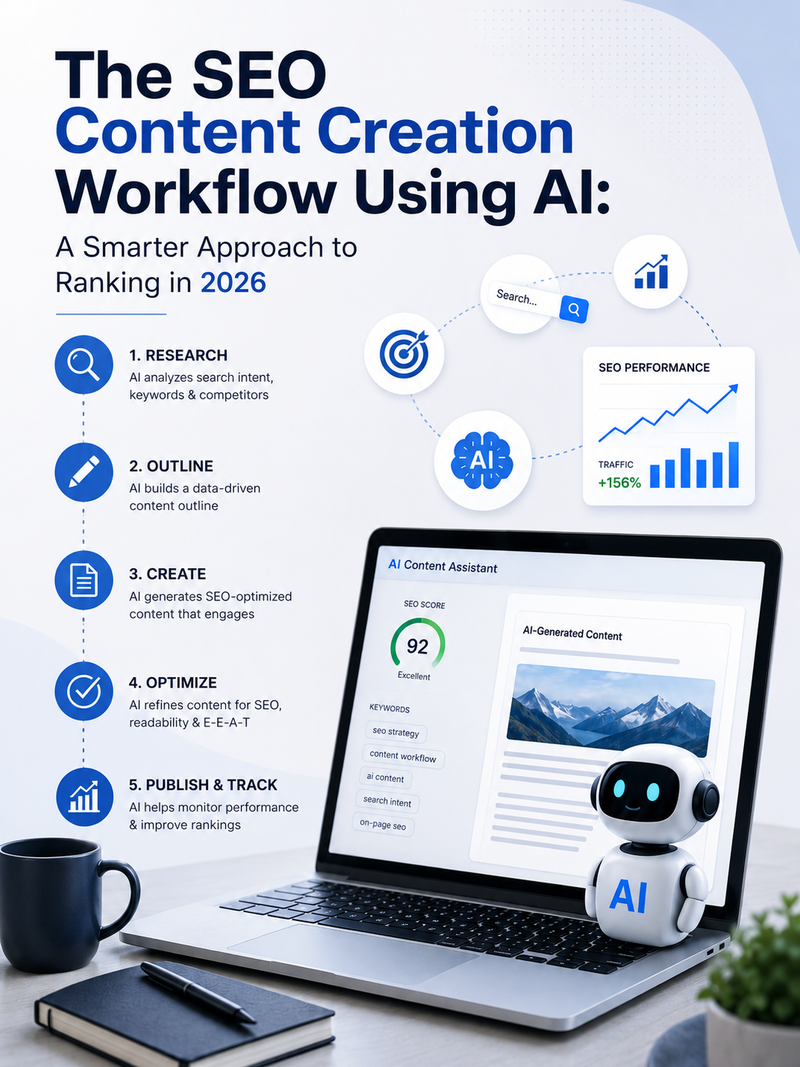
Finally, many people believe AI-generated content alone guarantees success. AI is an excellent assistant for brainstorming, summarizing, and drafting. Yet, sustainable authority means having original expertise, real-world experience, deep analysis, and real contribution.
Publishing has become faster due to technology. However, credibility cannot be replaced.
A Practical Framework for Modern SEO
The future of SEO can be summarized in a simple progression.
- Create Original Knowledge
- Ensure Technical Accessibility
- Develop Comprehensive Topic Coverage
- Build Trust Through Consistency
- Earn Recognition Across the Web
- Become Visible Across Search, AI, Social Platforms, and Industry References
This framework captures the methodology by which the modern masses give their attention. It is not through short, quick methods. It is through consistency and quality.
Final Thoughts
Search has transformed more in the last few years than in many years of the last decade. AI, semantic comprehension, conversational interfaces, and advanced ranking systems have changed the ways people discover and the way that information is displayed. Technology and how we think about things and alternatives have changed rapidly and will continue to do so, but one thing will always more or less hold:
The most useful information deserves the greatest visibility.
That principle explains why technical SEO still matters, why topical authority continues to outperform isolated keyword targeting, why E-E-A-T remains an important quality framework, and why original expertise has become one of the most valuable assets any organisation can develop.
Winning at SEO won't come from pursuing the latest AI advancements and algorithm changes. Winning at SEO will come from creating reliable, well-informed, easy-to-access, and helpful content.
Modern search is no longer the practice of finding pages. It is the science of understanding information. Modern SEO is no longer the practice of optimizing keywords. It is the discipline of building knowledge, earning trust, and becoming the source that both people and intelligent search systems choose to recommend.
As search continues to evolve, the websites that invest in expertise, clarity, originality, and long-term value will not simply survive the next generation of search. They will help define it.