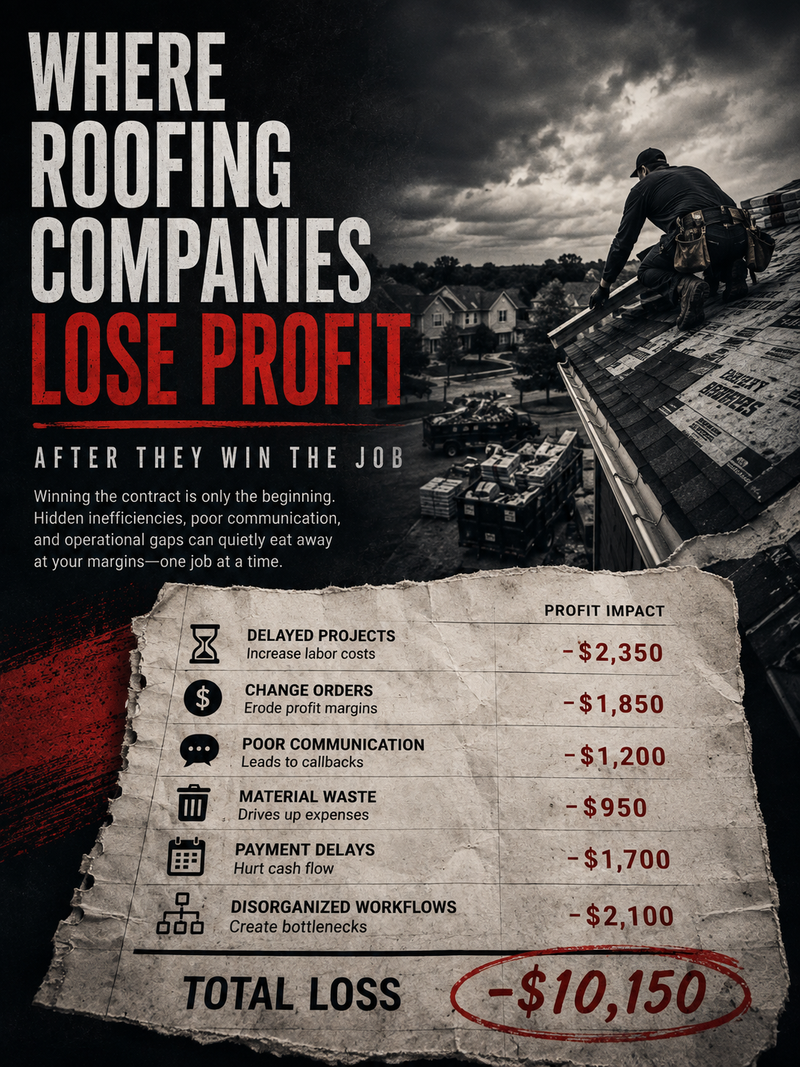
There is a particular kind of success that makes a roofing company owner nervous.
It usually arrives disguised as a record month. The phones are busy, the sales calendar is full, crews are booked further out than anyone expected, and the company is finally producing the revenue numbers that once seemed ambitious. Another estimator is being considered because the existing team cannot keep up with inspections. A second production coordinator is suddenly looking less like an unnecessary expense and more like a necessity. From the outside, everything looks exactly as it should. The company is growing.
Then the problems begin.
A production manager discovers that three jobs were promised for the same week. A supplier calls to say part of an order will arrive late. An estimator is waiting for insurance documentation before finalising a proposal. A homeowner who was perfectly comfortable during the sales process is now calling the office because no one has told them when the crew will arrive. Accounting is waiting on payments that leadership expected to have collected already. Someone asks whether the company can take another twenty projects next month.
The owner looks at the calendar and sees demand everywhere.
And yet the business feels less under control than it did when it was half the size.
That is one of the least comfortable moments in the life of a growing roofing company because it forces an uncomfortable question: what if the company does not actually have a lead problem? What if it has a capacity problem?
This distinction is important. The North American roofing market remains very promising for residential and commercial work and for restoration. Roofing Contractor’s research for 2025 shows that over half of contractors whose main work was residential reported an increase in volume in the past year, and that 72% anticipate that residential sales will increase in 2025.
Demand, in other words, is not automatically the scarce resource.
The scarce resource may be the company's ability to turn that demand into profitable work without allowing the customer experience, cash position, production schedule, or reputation to deteriorate.
That changes the question a roofing executive should ask about growth.
It is no longer simply, "How do we get more customers?"
It becomes, "How much profitable demand can this business absorb before growth begins working against us?"
That is a much harder question. It is also much more useful.
The Roofing Company That Grows Fastest Isn't Necessarily the One That Generates the Most Demand
Imagine two roofing contractors operating in the same broad market. Both have experienced estimators, established supplier relationships, capable crews, a functioning website, a Google Business Profile, and a respectable reputation. Then a major storm moves through the area, and inspection requests suddenly multiply.
The first company immediately increases its advertising budget. The owner sees the opportunity and does not want competitors taking the market. More calls arrive. More inspections are booked. The sales team feels the pressure almost immediately.
The second company has a new approach. Before increasing demand, the higher-ups consider the availability of estimators, inspection capacity, and the status of production schedules, as well as material commitments, supplemental workload, crew availability, and the office’s ability to communicate with customers. They determine how many additional projects the company can take on without negatively affecting existing contracts.
The first company may generate more leads.
The second may make more money.
The difference is not necessarily marketing skill. It is the ability to connect demand with productive capacity.
That distinction becomes especially important in storm restoration. A hail event affecting communities around Dallas–Fort Worth, Oklahoma City, or parts of Colorado can compress an enormous amount of potential roofing demand into a short period. The opportunity is obvious. The less obvious competition is for inspectors, estimators, crews, vehicles, materials, management attention, insurance documentation, and working capital.
A contractor that sees the storm primarily as a lead-generation opportunity sees only the beginning of the economic cycle. A contractor that sees it as an operational stress test understands that every additional customer creates obligations elsewhere in the business.
This phone call starts a whole process.
We need people to do all these things: check out the roof, record the damage, figure out the costs, and then actually talk to the homeowner about everything. There’s even more to do like deal with the insurance, order supplies, plan out who is doing the work (the crew), and even take care of getting paid. And once everything is complete, we stay accountable for our work and make sure everything is right!
A storm can therefore produce a remarkable quarter and a remarkable number of problems at the same time.
The companies that handle the difference well are rarely the ones that shout the loudest about how many leads they can generate.
They are the ones that know what happens after the lead arrives.
Growth Changes the Nature of the Business
A smaller roofing company can survive surprisingly long on informal systems.
The owner knows the estimators personally. The production schedule can be understood from a whiteboard. A customer can call the owner directly and receive an answer. Everyone knows which projects are waiting for materials and which homeowner has been asking for an update.
That model becomes increasingly fragile as the company grows.
At a larger operation, the owner may no longer know which projects are waiting on insurance decisions, which customers have received revised installation dates, which jobs have unresolved production issues, or which estimator is carrying too many opportunities. Information that once travelled naturally through conversation now has to move through processes.
This is where many roofing companies mistake a scale problem for a marketing problem.
The website may not be failing because lead volume has slowed. The CRM may not be failing because the pipeline looks messy. The sales team may not suddenly have forgotten how to sell. The company may have outgrown the informal operating model that worked when fewer people were involved.
Problems popping up in different areas of the organization can make it hard to identify the root cause.
Sales sees decisions being made only with a delay. Production is under pressure to meet scheduling demands. Accounting sees longer collection cycles. Customer service sees an increase in incoming calls. Leadership sees an increase in operating expenses. Marketing sees decreased conversion rates. Problems seem to be isolated to different departments when they are actually effects of the same problem.
The business has become too complex to run through memory, personal relationships, spreadsheets, text messages, and disconnected systems.
That is not fundamentally a marketing failure.
It is a business-design problem.
And it is one reason the conversation around roofing business growth has to become more sophisticated than simply asking how many leads a company can generate.
A Lead Is Not Revenue
The language of lead generation encourages roofing companies to condense a lengthy economic process into a single number.
A lead arrives.
The dashboard counts it.
The campaign gets credit.
But the business has barely begun.
A homeowner finds the business and reaches out. They set up a roof inspection. The company then assesses the condition of the roof. The homeowner receives an estimate and understands the recommendation. The proposal is favorable compared to that of other contractors, and the company answers any insurance questions. The homeowner signs the contract, and the company purchases the materials and schedules production. The company completes the roof, and the homeowner is satisfied. The company sends an invoice and remains liable for the artistry.
Every transition introduces the possibility of friction.
That is why a sophisticated roofing marketing strategy cannot be judged only by the number of enquiries it produces. The more useful measurement is what happens to those enquiries after they enter the business.
Suppose a campaign generates 100 additional enquiries, but the office cannot respond quickly enough to all of them. The marketing campaign may have done exactly what it was supposed to do. The organisation could not capture the value it created.
Suppose those enquiries become inspections, but proposals sit untouched for several days because estimators are overloaded with existing work. Again, the problem is not necessarily lead generation.
Suppose contracts increase, production becomes overwhelmed, installation dates begin slipping, and customers start calling repeatedly for updates. The marketing campaign did not create the underlying operational weakness. It exposed it.
That distinction matters because the appropriate response changes completely.
Sometimes the business needs another estimator.
Sometimes it needs better production planning.
Sometimes it needs stronger supplier coordination.
Sometimes it needs a better customer-communication process.
Sometimes it needs a CRM that actually reflects how work moves through the company.
And sometimes the smartest growth decision is to stop selling capacity that the company does not realistically possess.
That last decision can be particularly difficult for an ambitious owner. Turning away demand feels like failure when the company has spent years trying to create it. But profitable growth is not the same thing as maximum volume. A project that generates revenue while consuming disproportionate management time, delaying other work, damaging customer relationships, or yielding weak margins is not inherently good.
A full schedule can hide a weak business.
Not Every Roofing Company Has the Same Economic Problem
There is no single roofing customer, and there is no single roofing business model.
A homeowner planning a replacement in Phoenix is making a different decision from a homeowner dealing with hail damage outside Fort Worth. A commercial property manager responsible for several buildings in Chicago is managing a different risk from a homeowner in Toronto preparing for another winter.
The difference is not merely climate.
It is the buying process, the urgency, the decision-makers, the project timeline, and the economic consequences of getting the decision wrong.
Retail residential roofing can involve a long consideration period. The homeowner may compare several contractors, examine roofing systems, ask about ventilation and warranties, consider financing, and weigh whether a repair is sufficient or a replacement makes more sense. The contractor has an opportunity to educate the customer before the customer ever signs a contract.
Storm restoration operates under different pressure. Damage may have occurred yesterday. Several contractors may already be contacting the neighbourhood. Insurance documentation becomes part of the process. Inspection capacity becomes scarce. Speed matters, but speed without organisation can produce expensive mistakes.
Commercial roofing needs more thought. A facility manager may be juggling many things. These things can include: emergency response and maintenance of an occupied building, planning the building's lifecycle, and managing capital budget constraints, as well as the cost impacts of an operational roof failure. The contractor is not only pursuing the project but also the opportunity to become a reliable part of the property's risk management.
These are not three versions of the same marketing problem.
They are three different economic environments.
A company that treats all of them as variations of "generate more roofing leads" is likely to miss the more important question: which kind of demand creates the best combination of revenue, margin, operational fit, customer lifetime value, and future opportunity for this particular business?
That is where strategy begins.
The First Bottleneck Is Often Somewhere Nobody Is Looking
Imagine a roofing company invests heavily in generating demand over the course of a quarter. Website traffic rises. Calls increase. Inspection requests increase. The sales team is pleased.
Three months later, leadership reviews revenue and finds the improvement is smaller than expected.
The first question is usually, "Did marketing produce enough leads?"
A better question is, "Where did the additional demand stop moving?"
Employees in the office probably were not responding promptly. Estimators could have been spending too much time on the road. Proposals were probably not followed up on promptly. Insured customers were probably waiting too long for a decision. Production may have reached maximum capacity. There may also have been a shortage of materials needed for certain projects. For certain contracts, the company probably accepted projects and contracts that were interesting to it, but the profit was much lower than expected after the true costs were calculated.
The answer could exist anywhere between the first search and the final payment.
That is why mature roofing companies eventually have to stop treating marketing as a department operating beside the rest of the business. Demand enters the organisation at one end, and cash, customer satisfaction, reviews, referrals, and future opportunities should emerge at the other. Everything in between determines the return.
This is also where technology becomes useful—but only when it is tied to a real constraint.
A roofing company does not need a CRM simply because other roofing companies have CRMs. It needs one if opportunities, customer information, project status, or follow-up are being lost because the existing process cannot handle the company's scale.
Automation is valuable when employees are repeatedly performing predictable administrative work that does not require human judgement. Customer communication systems are valuable when homeowners repeatedly call because they cannot determine what is happening with their project. Analytics are valuable when leadership cannot distinguish between channels that generate enquiries and those that generate profitable customers.
Artificial intelligence can be useful when it removes repetitive work while leaving complicated decisions to people with the experience to make them.
The tool is secondary.
The constraint comes first.
Marketing Still Matters—But It Cannot Be Allowed to Carry the Business.
None of this means a roofing company should stop investing in marketing.
Quite the opposite.
A strong operating system that nobody can find will not produce the growth an established company wants.
Search visibility matters. A complete and accurate Google Business Profile matters. A useful website matters. Reviews matter. Local relevance matters. Good content matters.
Google says local search results are primarily influenced by relevance, distance, and prominence, and it specifically recommends that Business Profile information be complete and accurate. Google also notes that prominence can be informed by signals such as links and reviews.
But those signals should be understood in the context of the real business.
A roofing company cannot build durable visibility simply by producing pages around every variation of "roofing contractor near me." The more valuable opportunity is to document the knowledge customers genuinely need.
What should a homeowner do after discovering hail damage? What should be included in a roof replacement proposal? When does repair make more sense than replacement? What should a commercial property owner understand about preventative maintenance? What should a homeowner in a high-heat market ask about a roofing system? What should a facility manager evaluate before approving a large replacement project?
Those questions are valuable because customers actually have them.
They also create an opportunity for a roofing company to demonstrate its expertise rather than merely announce it.
That distinction matters increasingly in search. Google's current guidance asks whether content provides original information, substantial analysis, first-hand expertise, and meaningful value beyond what already exists. It also asks whether the content is something a reader would want to bookmark, share, or see referenced in a publication.
For roofing companies, that creates a useful standard.
Do not ask only what keyword should be targeted.
Ask what the company knows because it has actually done the work.
A contractor serving Phoenix may have years of experience dealing with the consequences of extreme heat and long-term exposure. A storm-restoration company in Oklahoma may have learned what homeowners repeatedly misunderstand after hail events. A commercial roofing company in Chicago may understand the scheduling and maintenance challenges that arise when major work has to be planned around occupied facilities and seasonal weather.
That knowledge is valuable.
The website is simply one place where it can become visible.
The Competitive Advantage That Cannot Be Bought Next Month
A competitor can increase its advertising budget tomorrow.
It can redesign its website.
It can hire an SEO company.
It can publish fifty articles.
It can purchase another software platform.
What it cannot purchase overnight is the business's history.
It cannot instantly recreate years of completed projects, customer experiences, local relationships, commercial accounts, operational knowledge, or reputation.
That accumulation is what makes an established roofing company potentially powerful.
One completed roof can create a satisfied customer. That customer may leave a review. The review becomes part of the company's public reputation. The project can become a documented example of the company's work. The customer may recommend the contractor to a neighbour. The neighbour may search for the company months later and encounter evidence that already exists.
None of this makes marketing irrelevant.
It makes marketing more interesting.
Marketing becomes the mechanism that helps the market discover value the business has already created.
That is a very different proposition from building a company that must constantly buy attention to remain visible.
The objective should be to create a business in which completed work makes future growth easier, not harder.
That means a roof installation should ideally create more than revenue. It should create experience, reputation, evidence, referrals, knowledge, and another reason for the next customer to believe the company can handle their problem.
Over time, those things compound.
And that compounding is one of the clearest differences between a merely busy roofing company and one that is becoming increasingly difficult to compete with.
What a Roofing Executive Should Ask Before the Next Marketing Investment
Before increasing the advertising budget, ask how quickly the organisation can responsibly absorb another twenty qualified opportunities.
Before hiring another salesperson, ask whether production can fulfil the additional contracts without compromising the customer experience.
Before launching another market, ask whether the systems that made the current market successful can actually travel with the business.
Before publishing another hundred pages, ask whether the company has something useful to say that its competitors have not already explained.
Before purchasing another technology platform, identify the specific bottleneck the platform is supposed to remove.
And before judging marketing by lead volume, follow one customer from the first search to the final payment.
That exercise can reveal more than another dashboard.
It shows where the business creates confidence and where it creates uncertainty. It reveals where information disappears, where employees lose time, where customers wait unnecessarily, where revenue slows, and where an additional marketing dollar is likely to create value rather than exacerbate an existing bottleneck.
The most useful marketing report, in other words, may not begin with impressions or clicks.
It may begin with the question:
What happened after the customer called?
The Growth Question That Matters
The roofing industry will continue to change. Weather will alter demand patterns. Insurance conditions will influence restoration work. Labour availability will affect production capacity. Material costs and distribution will influence margins. Search will continue to evolve. AI will change how homeowners research contractors and how businesses handle repetitive work. New competitors will enter established markets, while consolidation will change the competitive landscape in others.
None of those changes eliminate the fundamental problem.
A roofing company still has to turn demand into profitable, well-executed work consistently enough for growth to make the organisation stronger rather than simply larger.
That is a harder question than "How do we get more roofing leads?"
It is also the question that determines whether the leads are worth having.
SEO can help the right customer discover the company. A website can explain its expertise. Content can answer questions before the sales call. Reviews can provide evidence from previous customers. CRM systems can protect opportunities from being forgotten. Automation can reduce administrative friction. AI can help employees spend more time on work that requires judgement. Analytics can show leadership where growth is actually profitable.
But none of those things can substitute for the business behind them.
They can make it easier to find, understand, choose, and work with a good roofing company.
That is where digital strategy becomes genuinely valuable.
Not when it creates the appearance of a better roofing company, but when it makes the real company's strengths visible to people who are looking for them.
The roofing companies that will develop that connection may not be the companies that spend the most on advertising.
They will be the ones that understand what their business can do exceptionally well, build the systems required to deliver it consistently, and then make that reality impossible for the market to overlook.
That is a much more durable definition of growth.
And for a roofing company that intends to be around for another decade, it is probably the one that matters most.